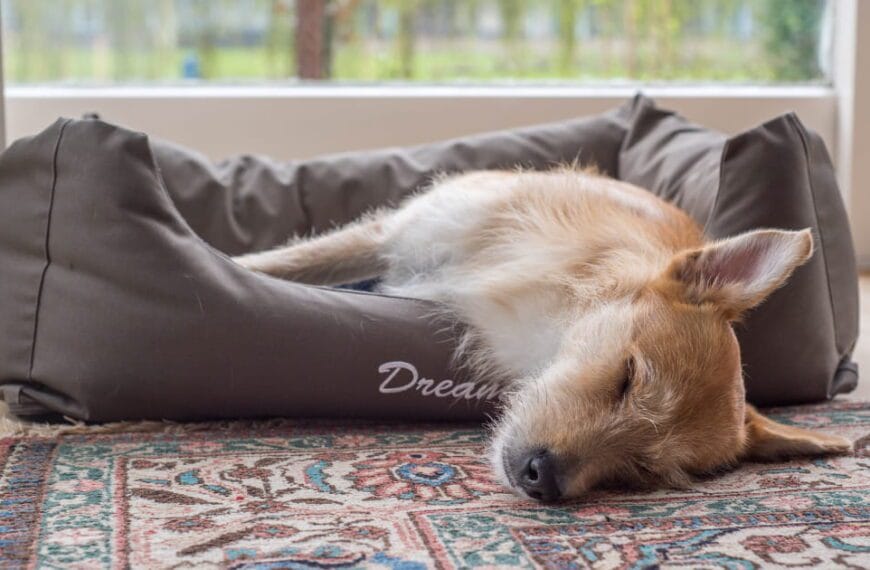
Dogs can be surprisingly selective about where they choose to sleep. The same dog that happily curls up on a pile of dirty laundry or a random spot on the floor may refuse to use their brand-new orthopedic bed.
If this sounds familiar, you are not alone. It is hard not to take it personally when a carefully chosen bed sits untouched while your dog settles somewhere else entirely — and you can’t figure out why.

We may view this behavior as stubbornness, but in reality, your dog is trying to communicate something. The challenge is figuring out what that is. In most cases, the answer comes down to the bed itself, where it is placed, or how your dog feels about it.
Whether the bed is brand new or one your dog has suddenly stopped using, this article will walk you through the most common reasons why your dog won’t use their bed and how to fix them.
At a Glance: What Your Dog’s Behavior Means
Not sure where to start? The table below breaks down common signs, what they point to, and where to look first. If something sounds familiar, jump straight to that section for more detail.
| If your dog… | It often points to… | Where to look first |
|---|---|---|
| Ignores a brand-new bed immediately | Unfamiliar scent | The Scent Problem |
| Steps on the bed, then instantly backs off | Texture or noise | Texture or Noise Problems |
| Lies down, then leaves after 10 to 15 minutes | Trapped body heat | The Bed Traps Too Much Heat |
| Sleeps right next to the bed but not on it | Poor fit or weak support | Lack of Support or Poor Fit |
| Avoids the bed in a busy area, or avoids an isolated spot and rests near you instead | Placement feels too exposed or too disconnected | Bed Location Is Too Busy or Isolated |
| Stops using it in a multi-pet household | Silent resource guarding | Multi-Dog Tension |
| Only avoids the bed at certain times of day | Drafts, sunlight, or floor-level temperature shifts | Temperature Problems at Floor Level |
| Suddenly rejects a long-time favorite bed but seems otherwise normal | Foam degradation or loss of support | Lack of Support or Poor Fit |
| Suddenly rejects a long-time favorite bed alongside restlessness, stiffness, or groaning | Possible medical discomfort | When to Call Your Vet |
| Circles the bed without approaching, or startles when they make contact with it | Fear of a new object | Fear of New Objects (Neophobia) |
| Approaches cautiously, hesitates at the edge, or avoids it after a stressful event | Negative association | Negative Associations with the Bed |
| Keeps choosing the couch, a rug, or a cool patch of floor instead | Preferred surface nearby | Why Your Dog Prefers Other Surfaces |
Pro Tip: If your dog fits into multiple categories, check to see if scent is the problem first. A dog is unlikely to test a bed’s support if the smell puts them off before they ever step on it.
Is It the Bed Itself?
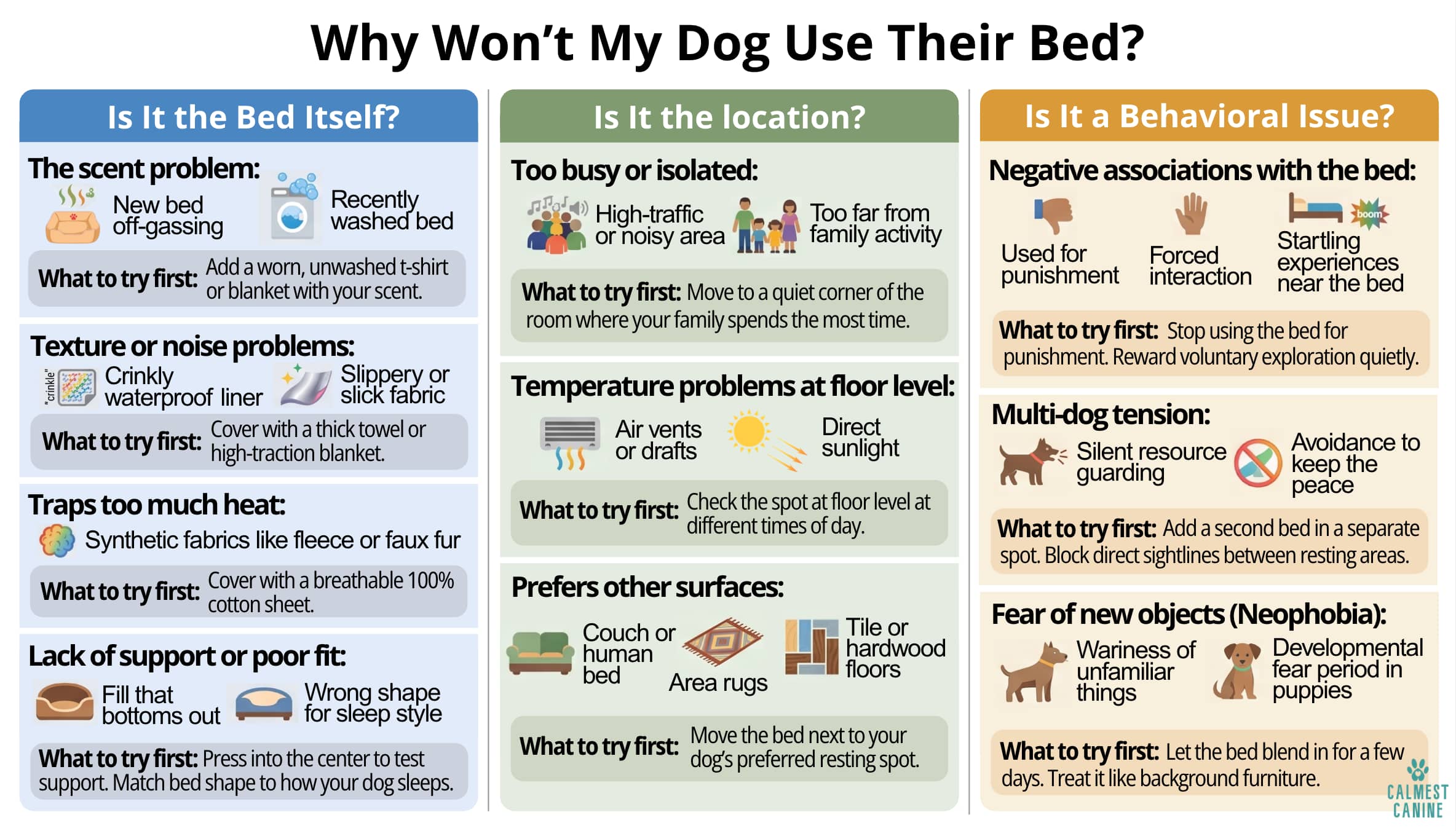
Dogs are sensitive to scent, sound, texture, and support, so when your dog is avoiding a new bed, the bed itself is the first place to look. A bed that looks comfortable to us may not feel right to them, and before writing it off as a bust, it helps to consider it from your dog’s perspective.
Does it smell right? Does it feel right? If something about the bed itself is off — whether it’s a strange factory scent, a slick texture, or a crinkly sound — moving it to a new room won’t be enough to make it appealing.
The Scent Problem
Dogs rely heavily on smell to understand their environment, far more than humans do. In fact, a dog’s sense of smell is estimated to be at least 100,000 times more sensitive than ours.
💡 How Sensitive Is a Dog’s Nose?
To put that into perspective, a dog can detect the equivalent of a 1/2 teaspoon of sugar dissolved in an Olympic-sized swimming pool. What barely registers as a faint chemical smell on a new bed may be completely overwhelming for your dog.
To your dog, a brand-new bed doesn’t smell like a comfort upgrade; it just smells unfamiliar. This unfamiliar scent usually comes from two main sources:
- New Bed Smell (Off-Gassing): Unused pet products often carry manufacturing chemical residues, shipping odors, and plastic smells that are barely noticeable to us but overwhelming to a dog.
- Recently Washed Bed (Loss of Familiar Scent): Even your dog’s longtime favorite bed can become unappealing after a wash. Cleaning it strips away the familiar scent your dog had already associated with safety and comfort.
If your dog sniffs the bed and walks away, scent is one of the first things to check.
What to Try First: Place a worn, unwashed T-shirt or blanket on the bed to help it smell more familiar right away. For the complete process, see Fix the Scent below.
Texture or Noise Problems
Another factor that can cause your dog to avoid their bed is how it feels. Beds that are noisy, slippery, or unstable make it difficult for a dog to relax and settle.
Most dogs would rather sleep on a hard floor or even a pile of laundry than on an uncomfortable or unsettling bed. This discomfort usually stems from noise, texture, or both:
- Crinkly Waterproof Liners (Noise): Many beds hide waterproof liners beneath the outer cover. While useful for managing accidents, the liner can create a rustling sound when your dog moves. For sound-sensitive or anxious dogs, a bed that crinkles with every moment can feel unpredictable and unsafe.
- Slick or Slippery Fabrics (Texture): Materials like heavy nylon or faux-leather can feel slippery under your dog’s paws. If your dog cannot get good traction when standing up, settling down, or turning around, they may avoid the bed in favor of a more stable surface.
If your dog hesitates at the edge of the bed, slips when stepping on it, or gets up shortly after lying down, noise or texture may be the issue.
What to Try First: Run your hand across the bed. If you hear loud crinkling, placing a thick towel over the liner can help reduce the noise. If the surface feels too slick, drape a high-traction blanket over the top to improve grip. For more in-depth solutions, see Fix the Surface below.
The Bed Traps Too Much Heat
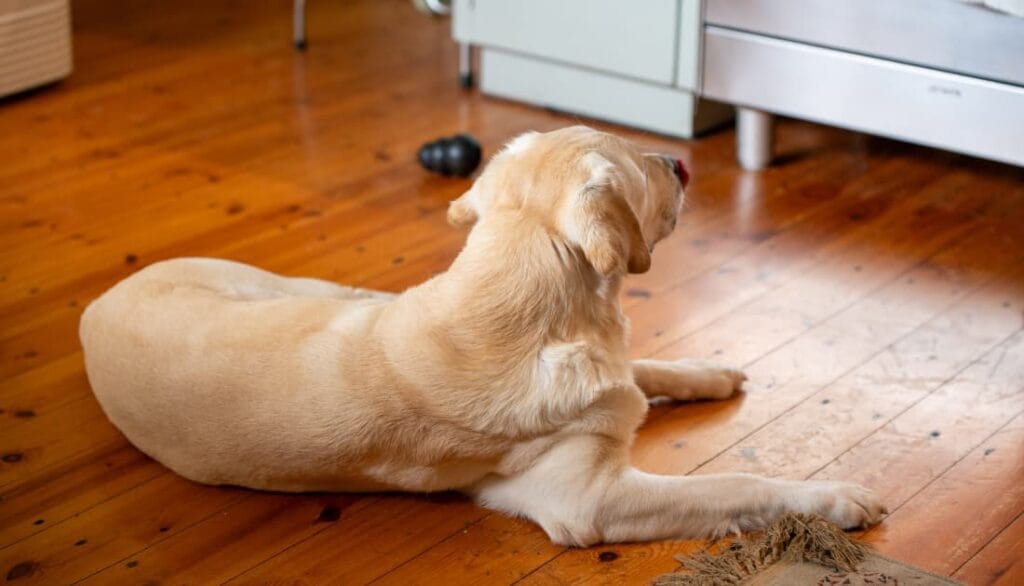
Even if a bed looks soft and cozy to us, it may actually feel too warm for your dog. Many popular dog beds use synthetic fabrics like faux fur, polyester fleece, or microfiber, which can trap heat and raise your dog’s body temperature.
This can be especially uncomfortable for dense- or double-coated dogs, or those that naturally run warm. Instead of settling in, your dog may lie down, then get up after 10 to 15 minutes and move to a cooler surface, such as tile or hardwood. If this happens regularly, the bed’s material is likely the reason.
What to Try First: Before replacing the bed, try covering it with a breathable, 100% cotton sheet or towel. Cotton allows for better airflow, which helps the surface feel cooler. For more cooling options, see Fix the Surface below.
Lack of Support or Poor Fit
Your dog’s bed may smell right and feel like the right temperature, but it can still fail if it does not properly support your dog’s body or match how they naturally sleep.
A good bed should distribute your dog’s weight evenly and keep their pressure points from sinking through to the floor. It should also match how your dog naturally sleeps, whether they curl up, sprawl out, or like to lean against an edge.
The two most common reasons a bed can structurally fall short are:
- Beds That “Bottom Out”: Fiber-filled beds and low-density foam may feel plush at first, but the constant weight of a medium- or large-breed dog can compress the fill over time. When that happens, your dog’s hips, shoulders, and elbows sink through the padding and press against the floor instead of being supported by it.
- The “No-Edge” Problem: Flat mattress-style beds can offer good orthopedic support, but some dogs do not like sleeping on an open surface. Dogs that curl up often want a raised edge or boundary to lean against, and without that sense of enclosure, they may avoid the bed entirely.
It is also worth considering that sometimes the bed hasn’t changed — your dog has.
As dogs age, they often lose muscle mass and body padding, which means a bed that once felt comfortable may no longer provide the support they need. In these cases, the foam of the bed may not provide the level of support their body now requires.
What to Try First: Press your palm firmly into the center of the bed. If you can easily feel the hard floor underneath, the bed has lost its support and likely needs a firmer insert or a topper. If the support still feels adequate, the issue may be the bed’s style rather than the fill. A dog that curls up but has no edge to lean against, or one that sprawls but cannot fully stretch out, may simply need a different shape. For more, see Fix the Size and Support.
Is It the Location?
Even if the bed checks every box, including the right scent, the right material, and enough support, it can still go unused if it is placed in the wrong spot.
Location is one of the most overlooked factors in bed avoidance, and it is often the reason a perfectly good bed sits untouched while your dog naps somewhere else entirely. Dogs are highly aware of their surroundings, which means where their bed sits can affect how safe and comfortable they feel using it.
A spot that seems perfectly fine to us may feel too exposed, too isolated, too loud, or too warm to your dog. As a result, placement problems usually come down to one of three things: how your dog feels in that spot, the temperature at floor level, or whether a nearby surface feels more appealing.
Bed Location Is Too Busy or Isolated
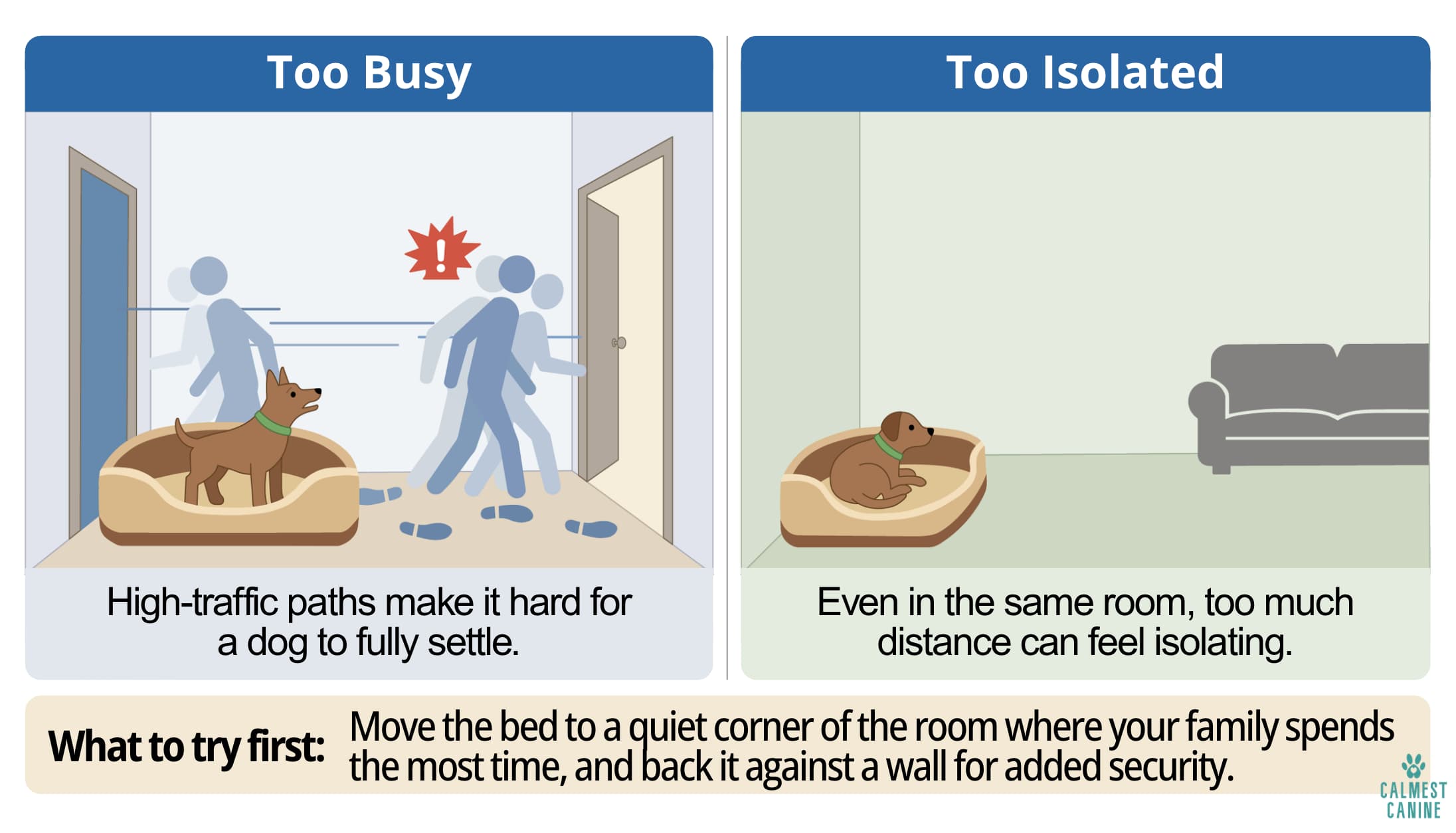
Dogs are social animals. Not only do they want to feel safe while they rest, but they also want to stay close to their people.
Through thousands of years of domestication, dogs have evolved to form strong attachment bonds with their human caregivers. Research suggests they seek out human proximity not just for food and protection, but for genuine social comfort.
This is why placement matters more than most owners expect — a bed placed too far from that connection can feel just as wrong as one that puts them in the middle of a chaotic space. It usually fails for one of two reasons: the spot is either too exposed or too isolated.
- The “Too Busy” Placement: A bed in a hallway, near a slamming door, or in the middle of a noisy kitchen makes it hard for a dog to relax. If they are constantly startled or forced to stay alert, they may avoid the bed in favor of a quieter, more protected spot.
- The “Too Isolated” Placement: A bed in a distant spare room or a corner cut off from family activity can also be unappealing. Dogs are social animals who want to stay close to their family. If its location feels too disconnected from the household, they may prefer the hard floor at your feet instead.
If your dog avoids the bed in a busy or high-traffic area but naps freely elsewhere, the spot may feel too chaotic for rest. If they ignore a bed placed in a separate room and instead choose the floor near where you are sitting, the location may feel too isolating.
What to Try First: Move the bed to a quiet corner of the room where your family spends the most time, and back it against a wall for added security. For more placement suggestions, read more in Fix the Bed’s Location below.
Temperature Problems at Floor Level
Most of us gauge a room’s temperature at standing height, but your dog experiences it differently. The temperature at floor level can feel like a completely different climate, with cooler air near drafts, warmer air near vents, and shifting sunlight throughout the day.
Small changes in airflow and heat that barely register to us can make a specific spot genuinely uncomfortable for a dog, and if that spot happens to be where their bed is, they will look for somewhere else to rest.
The most common temperature-related culprits at floor level are:
- Air vents and drafts: A bed placed under or near an HVAC vent can get hit with sudden blasts of hot or cold air. Drafts from exterior doors or older windows can also make a floor-level spot too uncomfortable to settle into.
- Direct sunlight: A bed that feels comfortable in the morning may become too hot later in the day if it sits in direct sunlight for several hours. If your dog only avoids it at certain times of day, it is worth tracking how sunlight moves across that spot.
If your dog settles on the bed at certain times of day but consistently avoids it at others, sunlight or shifting air temperature at that spot may be the reason.
What to Try First: Get down to floor level and check for drafts, vent blasts, and direct sunlight at different times of day before settling on a permanent spot. For more temperature-related solutions, head to Fix the Bed’s Location below.
Why Your Dog Prefers Other Surfaces
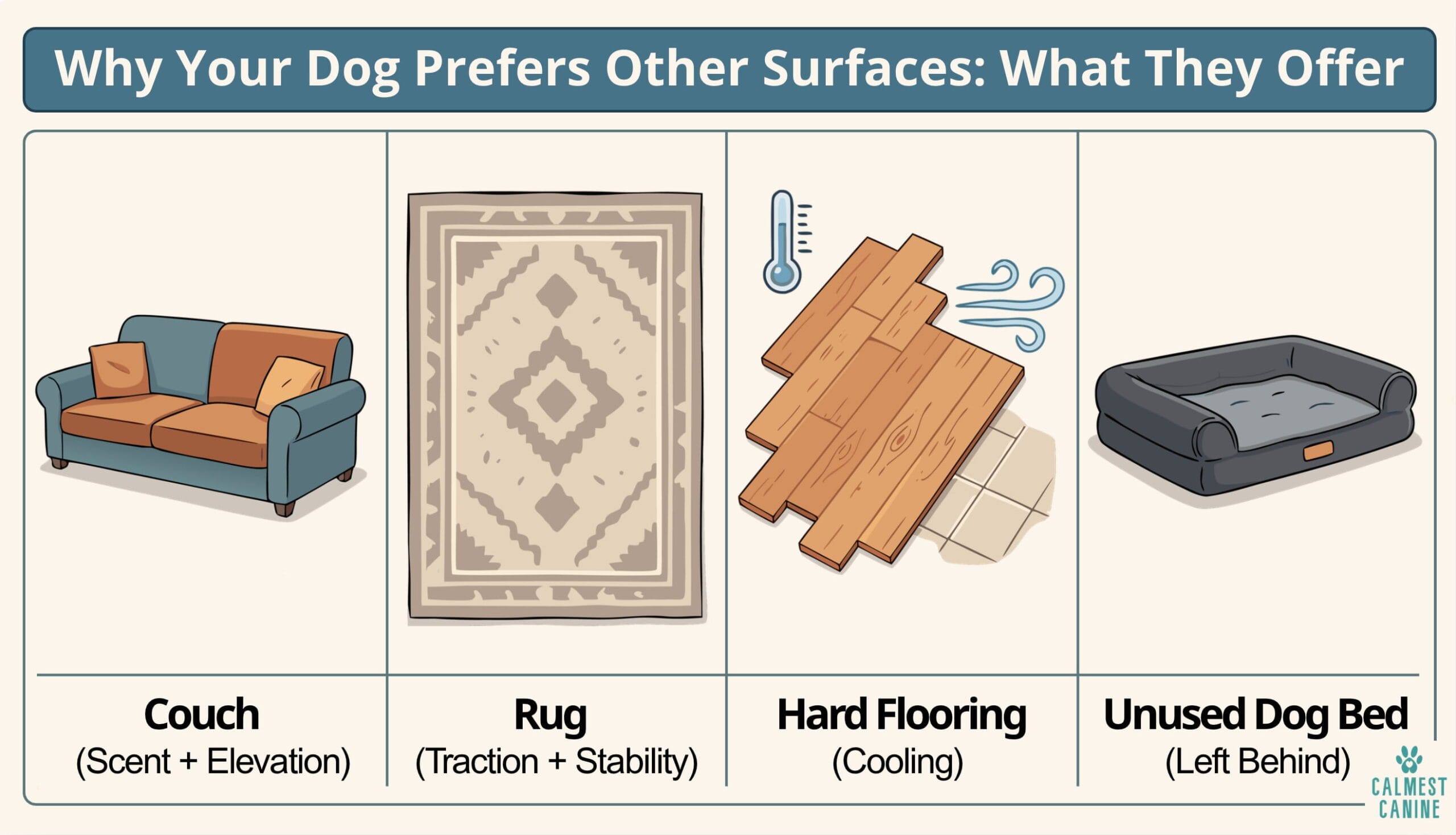
Dogs are good at finding the right mix of comfort, footing, and temperature. If another surface in the house checks more of those boxes than the bed does, they will use that instead. This is not always a bed problem. Sometimes it is a competition problem.
Your dog may be gravitating to another surface for one of three common reasons:
- The couch or human bed (scent and elevation): Furniture carries your scent, and to your dog, that familiarity signals safety. Elevated surfaces also give dogs a better vantage point for keeping an eye on their surroundings, something a floor-level bed cannot offer.
- Area rugs (traction and stability): A low-pile rug can feel more stable underfoot than a bed that slides on hardwood or tile. This is especially true for older dogs or dogs with joint or mobility issues.
- Hardwood and tile flooring (cooling): Hard floors do not trap body heat, which makes them appealing to thick-coated dogs or dogs that run warm and need to cool down quickly.
If your dog consistently gravitates toward the couch, a favorite rug, or a cool patch of floor instead of their bed, pay attention to which surface they choose and where. It will usually tell you exactly what the bed is missing.
What to Try First: Move the bed to the edge of your dog’s favorite rug or next to their preferred resting spot. For additional ways to make your dog’s bed more appealing, see How to Out-Compete the Couch below.
Is It a Behavioral Issue?
If you have already ruled out issues with the bed itself and its location, the reason your dog is avoiding their bed may be emotional rather than physical. This is less common than a scent or placement issue, but it is worth considering if nothing else has explained the behavior.
A dog may reject their bed because of a past negative experience, social pressure from another pet in the home, or a natural wariness of new objects. In each case, the bed is not the problem. How your dog feels about it is.
Negative Associations with the Bed
Your dog may lose trust in their bed if it becomes associated with something stressful, even unintentionally. Like humans, dogs connect specific places with experiences, whether good or bad.
Picture this: your dog is resting on their bed when a loud noise startles them, a child rushes over to pet them, or another pet corners them in that spot. The bed itself did nothing wrong, but your dog now associates that space with feeling uneasy or unsafe.
It only takes one or two experiences like that for a dog to start avoiding a spot they previously had no issue with. The most common triggers include:
- The “Go to Your Bed” Punishment: If the bed is used for time-outs or isolation, your dog may start to see it as a place where unpleasant things happen, turning their intended safe space into the exact opposite.
- Forced Interaction: Dragging or pushing a hesitant dog onto a new bed to “show them how soft it is” creates immediate pressure. Instead of feeling reassured, the dog associates the bed with stress, pressure, and a loss of agency.
- Startling Experiences: Whether it’s a loud noise, a rough wake-up, or sudden interactions from a child or another pet, startling situations while your dog is resting can make them lose trust in that space.
If your dog used to lay comfortably on their bed but now approaches it cautiously, hesitates at the edge, flattens out nearby instead of lying down, or has started avoiding it after a stressful event, a negative association may be the reason.
What to Try First: Stop using the bed for punishment, keep stressful interactions away from that space, and quietly reward your dog for approaching on their own. For more strategies to strengthen your dog’s connection with their bed, see Build a Positive Association below.
Multi-Dog Tension
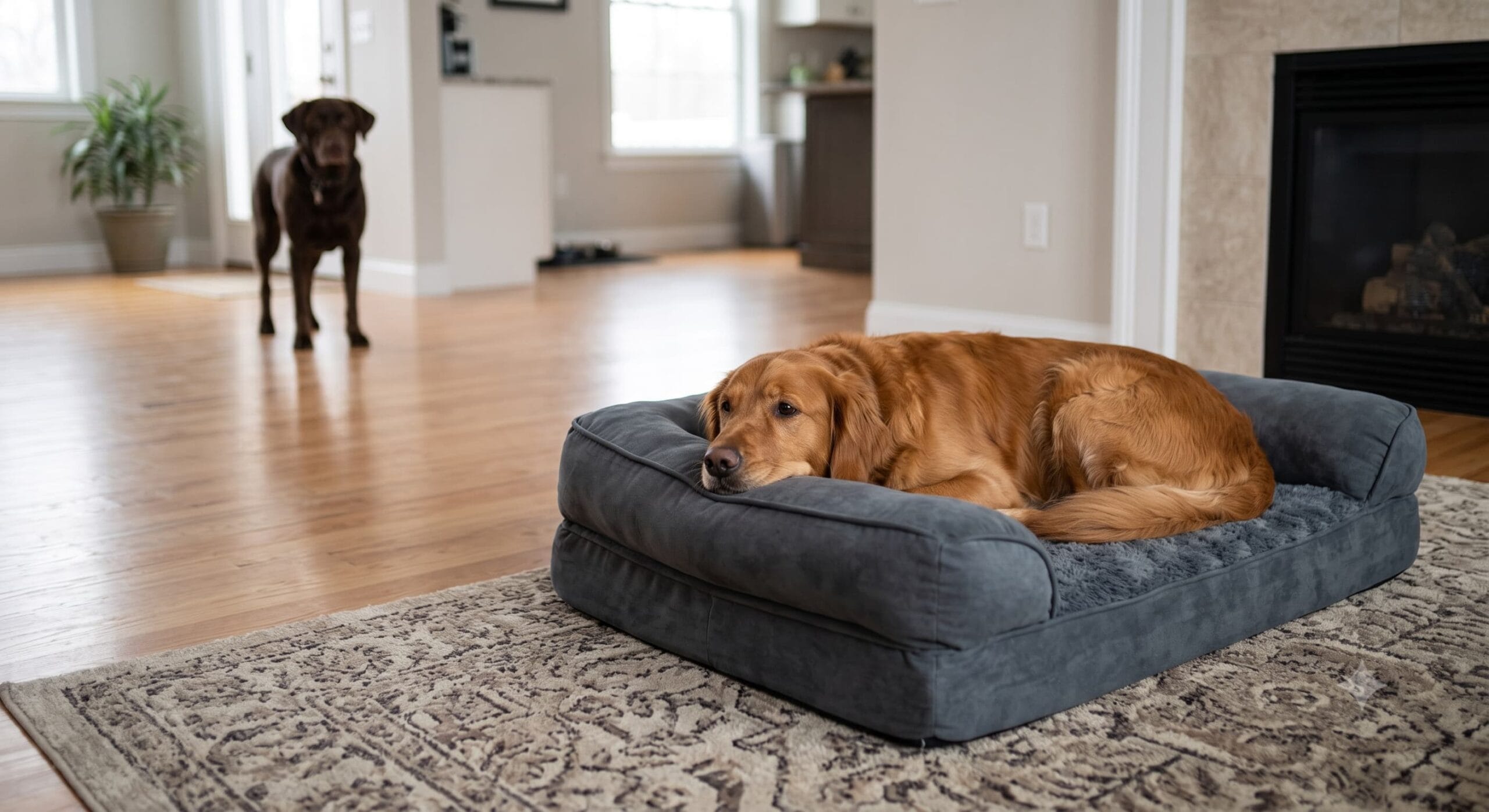
If you have more than one dog in your home and one of them has stopped using their bed, it is worth considering whether social pressure from another pet may be involved.
A room can look peaceful even as one dog quietly blocks or crowds another out of a space. To avoid confrontation, the less confident dog may choose the floor instead.
Signs this may be happening include a dog that approaches the bed but then backs off when the other dog is nearby, waits until the other dog leaves before settling, or shows subtle stress signals such as lip-licking, yawning, or looking away in that dog’s presence.
These are easy to miss if you do not know what to look for. It usually plays out in one of two ways:
- Silent Resource Guarding: A confident dog does not have to growl or snap to claim a bed. Watch for a dog that consistently stands near the bed, blocks access, or holds a stiff, unblinking posture when the other dog approaches. The message is clear to the other dog, even if it is invisible to you.
- The Avoidance Strategy: A dog that consistently sleeps on the floor while another takes the bed may be keeping the peace rather than expressing a genuine preference for the floor.
If this dynamic sounds familiar, the fix is less about the bed and more about how the space is set up.
What to Try First: Add a second bed and place it somewhere separate, not right beside the first one. If possible, use furniture to block direct sightlines so each dog can rest without feeling watched or blocked. If the guarding behavior is persistent or has escalated to growling, consult a certified force-free dog behaviorist to assess the household dynamic safely. To learn more, continue to Resolve Multi-Dog Tension.
Fear of New Objects (Neophobia)
Some dogs are wary of new or unfamiliar objects. This is especially common in rescue or shelter dogs, senior dogs, and cautious breeds. It also shows up in puppies going through a normal developmental fear period, when something that seemed fine yesterday can feel threatening today.
For a neophobic dog, a brand-new bed can feel strange instead of appealing.
Rather than seeing it as a comfortable upgrade, these dogs prefer to monitor it from a safe distance before approaching, let alone using it. Pushing them to interact too quickly will only deepen their uncertainty.
If your dog circles the bed without approaching, keeps their distance while occasionally glancing at it, or startles when they accidentally make contact with it, wariness of the new object may be the reason rather than anything wrong with the bed itself.
What to Try First: Place the bed in a low-pressure spot and leave it completely alone for a few days. Treat it like a boring piece of background furniture and let your dog investigate at their own pace. For more details, check out the step-by-step guide on how to help your dog adjust to a new bed.
How to Get Your Dog to Use Their Bed
Now that you know what might be keeping your dog off their bed, use the steps below to address the issue. If you have already identified the likely cause, skip ahead to the relevant section below.
Fix the Scent
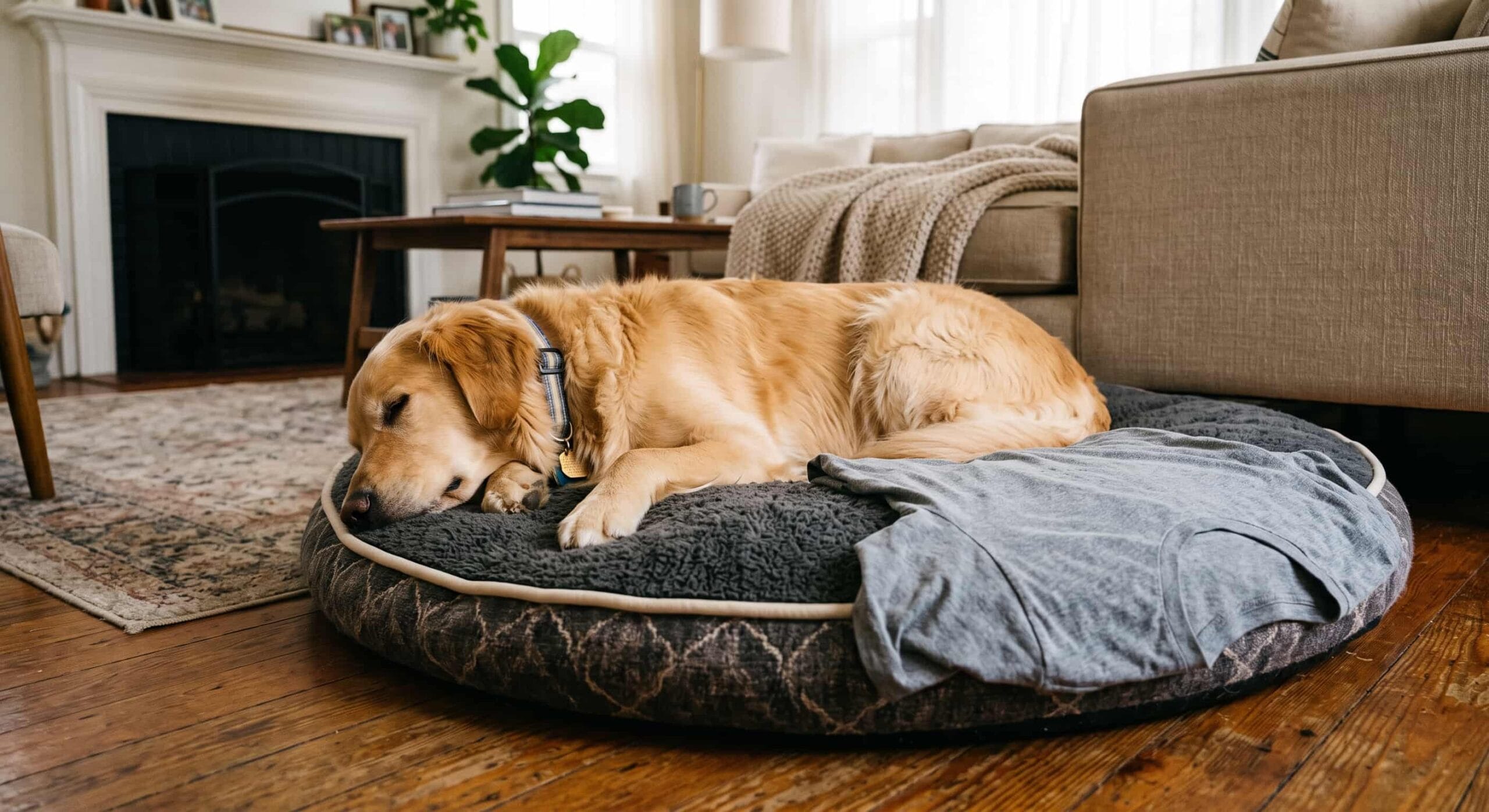
If the bed is brand new, it may smell like factory chemicals, plastic, or synthetic materials, none of which are familiar or reassuring to your dog. A couple of steps can help ease the transition:
- Wash It Before Use: Always wash a new, machine-washable bed or removable cover before giving it to your dog. Use an unscented, hypoallergenic detergent to strip away factory residues.
- Add a Familiar Scent: Drape a worn, unwashed T-shirt or a blanket you have slept with for a few nights over the bed. Your scent signals to your dog that the space is safe and familiar, replacing unfamiliar odors with something they already trust.
⚠️ What to Avoid:
Fabric softeners, dryer sheets, and scented sprays or pet deodorizers can replace one unfamiliar smell with another. Stick to unscented products only.
If your dog’s existing bed has been recently washed, the problem is different. Washing strips away the scent markers your dog associated with safety and comfort, making a once-familiar bed feel new again.
- Restore the Familiar Scent: Drape a worn, unwashed T-shirt or slept-in blanket over the bed and give your dog a few days to resettle. Going forward, try to space out washes and let your dog’s scent rebuild between them rather than washing on a fixed schedule.
If you would like to learn more about the best way to wash a dog bed, read How to Wash a Dog Bed With Stuffing.
Fix the Surface
If the surface itself seems to be the issue, you do not necessarily need a new bed. In many cases, a cover swap or an added layer is enough. The right fix depends on what is actually bothering your dog.
- Fix the Noise: If you hear a crinkling or rustling sound when your dog shifts or steps on the bed, a waterproof liner is likely the culprit. Try placing a thick towel or quilted blanket over the surface to soften the sound.
- Fix the Traction: If your dog hesitates at the edge of the bed, slips when stepping on, or avoids it in favor of a rug or carpet, the surface may feel unstable underfoot. Add a textured layer that gives their paws more grip — a quilted throw or low-pile cotton cover can help.
- Fix the Temperature: If your dog settles briefly but consistently moves to tile or hardwood, the bed is likely trapping too much heat. Try covering it with a 100% cotton sheet or towel to allow better airflow. When shopping for a replacement, look for a cooling gel layer or breathable mesh cover.
Not every issue with the bed’s surface is about the material itself. Sometimes the bed is fine, but it moves too much to feel secure.
- Fix the Base: If your dog consistently chooses a nearby rug or carpet over their bed, the bed may be sliding when they try to step onto it. Place an inexpensive non-slip rug pad beneath the bed to anchor it to hardwood or tile floors.
If adding a layer over the surface helps but does not fully solve the problem, replacing just the cover is worth trying before investing in a new bed entirely.
Fix the Size and Support
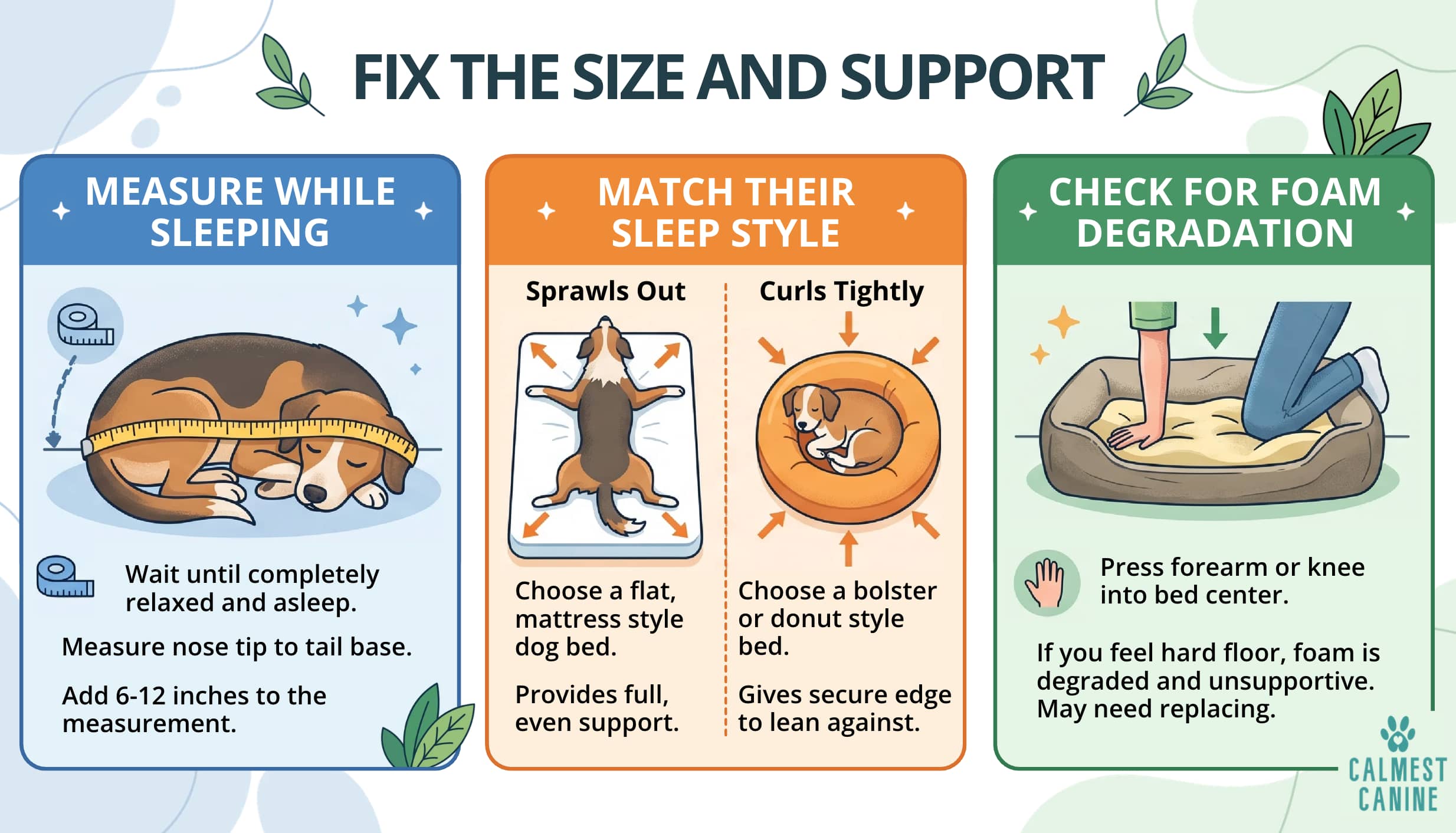
If your dog lies down on the bed, gets up, circles, and repeats the process without ever fully settling, the bed may not fit the way they sleep.
Match the Bed to How They Sleep
A bed that is too small can prevent a dog from fully stretching out, while one that is too wide can leave a dog that likes to curl up feeling exposed without an edge to lean against.
- Measure While Sleeping: Wait until your dog is completely relaxed and asleep, then measure from the base of their tail to the tip of their nose. Measuring while they sleep gives you their natural resting size instead of a guess based on weight alone.
- Match Their Sleep Style: If your dog sprawls out, choose a flat mattress and add 6 to 12 inches to your measurement. If they curl tightly, choose a bolster or donut-style bed that gives them a secure edge to lean against.
Quick Reference: Match Sleep Style to Bed Structure
| If your dog prefers to sleep… | They are looking for: | Best bed structure: |
|---|---|---|
| Flat on their side, limbs fully extended | Maximum surface area and zero pressure points | Large orthopedic mattress |
| Curled into a tight ball | A solid physical boundary to press against | Bolster bed or calming donut |
| Tucked underneath furniture (like a table or desk) | An enclosed, low-ceiling environment | Cave bed or covered igloo |
| Sprawled on their back, legs in the air | Open space with no pressure on the spine | Large flat mattress or roomy bolster bed with space to stretch |
Check for Worn-Out Support
If the bed is older, the issue may not be size alone. Degraded foam that no longer provides adequate support can cause the same restless behavior. Your dog keeps adjusting because they cannot get comfortable, rather than because the bed is the wrong shape.
- Check for Foam Degradation: Press your forearm or knee into the center of the bed. If you can easily feel the hard floor beneath, the insert is no longer supportive and may need to be replaced. If the cover is still in good shape, replacing just the insert can be a cheaper fix than buying a whole new bed.
Fix the Bed’s Location
If your dog consistently avoids their bed in favor of a specific spot on the floor, a corner of the room, or a place closer to where you are sitting, the bed itself may not be the problem. The location is.
No amount of extra padding will convince a dog to use a bed in the wrong spot, so before buying a replacement, start by adjusting where the current one sits.
- Let Them Pick the Spot: If your dog ignores their bed but consistently returns to a specific patch of floor, corner, or gap in the room, that spot is telling you something. Move the bed there and work with their instincts rather than against them. If you’re unsure, start with that spot, add a familiar scent, and give it two weeks before making further changes.
- Balance Safety and Connection: If your dog approaches the bed but never fully settles, or is easily startled while resting, the spot may feel too exposed. Move it out of high-traffic paths where your dog may feel startled or accidentally stepped on. At the same time, keep it in the room where the family spends time so your dog can maintain a line of sight to you and still feel included.
- Check for Temperature Issues: If your dog settles on the bed briefly but then gets up, and you’ve already ruled out the bed itself, the temperature of that spot may be the issue. Check at floor level for drafts, vent airflow, direct sun, or heat from nearby windows. A spot that feels comfortable to you may be too hot, too cold, or too breezy for your dog.
For a more in-depth guide to placement, see How to Choose the Perfect Location for Your Dog’s Bed.
How to Out-Compete the Couch
Even with the bed in the right spot, your dog may still choose the couch, a favorite rug, or a patch of bare floor over it. When that happens, the surface they keep returning to is showing you what the bed is missing, whether that’s your scent, a cooler temperature, better traction, or a higher vantage point.
The goal is not to block access to those surfaces. It is to understand what they are offering and make the bed a closer match. Start by looking at what your dog chooses instead of their bed:
- The Couch or Your Bed (Scent): Furniture carries your scent in a way a new or freshly washed dog bed doesn’t, which can make it more appealing. See Fix the Scent to learn how to close the gap.
- A Rug or Carpet (Traction): Rugs provide a more stable, non-slip surface, which can make it easier for your dog to settle and get up. Learn how to add grip or anchor the bed in Fix the Surface above.
- Tile or Hardwood (Temperature): These surfaces stay cooler, which can help dogs regulate body temperature. Switching to cooling covers can help out-compete those spots. Learn how in Fix the Surface above.
If those do not resolve the issue, try these next:
- Match the Vantage Point: If your dog gravitates to the couch, the draw may be the elevated sightline rather than the comfort. Dogs can feel more secure when they have a clear view of the room, a preference also seen in studies of how dogs choose resting spots. A sofa-style dog bed with a raised back or bolstered frame can replicate that without giving up a dedicated sleeping space.
- Place the Bed Alongside the Competition: Instead of positioning the bed away from your dog’s preferred spots, move it next to them. Place it at the edge of their favorite rug, beside the couch, or in the corner where they already rest. A bed in the right location will often outperform a better bed in the wrong one.
Build a Positive Association

If your dog’s hesitation around their bed stems from a negative experience, the fix is not to replace it but to rebuild what your dog feels when they are near it.
A dog that approaches cautiously, sniffs and walks away, or circles without lying down may need time and positive reinforcement to feel safe in that space again. Pairing the bed with calm, rewarding moments is the most reliable way to get there.
- Move Mealtime Near the Bed: Start by placing the food bowl near the bed, then gradually move it closer over several days as your dog relaxes. Once they are comfortable eating beside it, move the bowl onto or just beside the bed. Over time, this helps your dog associate it with something positive and rewarding.
- Reward Voluntary Exploration: Keep high-value treats nearby. Whenever your dog sniffs, approaches, or touches the bed on their own, offer calm praise and an immediate reward. Reinforcing these small voluntary moments builds trust without creating pressure.
- Never Force Interaction: Do not drag, lift, or place your dog on the bed. Forcing a dog into a space removes their sense of control and makes the bed feel unsafe rather than comforting, which is the opposite of what you are trying to build.
Progress can take anywhere from a few days to a couple of weeks. Slow is normal, not a sign it isn’t working.
Resolve Multi-Dog Tension
If you have noticed the subtle signs of social pressure commonly associated with multi-dog tension — a dog that veers away from their bed, waits for the other dog to leave, or shows stress signals like lip licking or yawning near the space — the goal is not to discipline the guarding dog but to reduce competition between them.
Setting up the environment so that each dog has their own clearly defined, separate resting spot removes the need for either dog to feel like they have to compete for or defend a resource. Here is how to do that:
- Create Separate Zones: Provide each dog with their own bed and place them far enough apart to avoid crowding. Avoid beds that are clearly more appealing than others, since that can invite comparison or resource guarding.
- Block Direct Sightlines: Distance alone isn’t always enough. Use existing furniture, such as a couch, armchair, or bookcase, to interrupt the direct line of sight between the resting spaces. When a less confident dog cannot see the other dog watching them, they can relax more easily.
- Build Positive Associations: Feed meals or offer long-lasting chews like stuffed KONGs near each dog’s bed so the space feels calm and rewarding. This helps each dog build a positive connection with their own resting spot.
If a dog is guarding the bed, growling, or making another dog uncomfortable, restrict access to the area and consult a certified force-free dog behaviorist to assess the household dynamics safely.
Help Your Dog Adjust to a New Bed
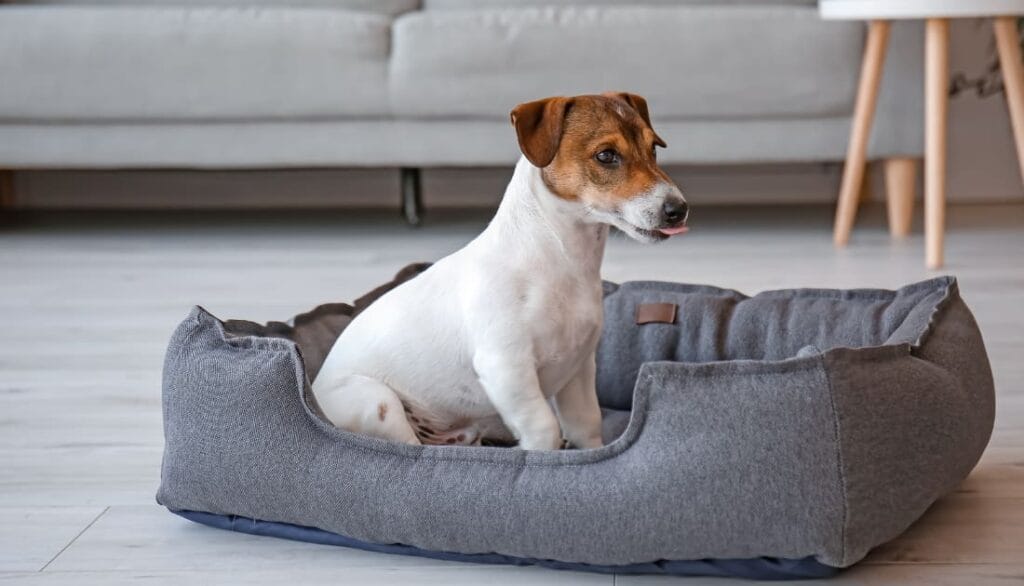
In some cases, everything is done right: you got a new bed, washed it, added your scent to it, and placed it in a well-thought-out spot, and your dog still will not go near it.
If this sounds familiar, the issue may not be the bed itself, but the fact that it’s a new object in their environment. Some dogs are naturally cautious around unfamiliar items, even items intended for their comfort.
Rather than further adjusting the bed’s scent, material, or location, the most effective thing you can do is give your dog time and space to get to know the bed on their own terms. These steps can make that transition a little easier:
- Let the Bed Blend In: Position the bed in a low-pressure area, such as a room corner or a quiet hallway, where your dog can see it without feeling trapped. Leave it completely alone for the first few days, treating it like a boring piece of background furniture.
- Make it Less Imposing: If the bed looks visually large or intimidating, flatten it or cover it with a familiar blanket to make it feel less new. This helps mask the visual newness and makes the bed look like a natural extension of the floor.
- Reward Low-Level Curiosity: Avoid holding a treat directly over the bed to lure your dog onto it. This creates a push-pull conflict where they want the treat but are uncertain about the bed. Instead, if your dog glances at it, sniffs nearby, or moves a little closer on their own, quietly reward that curiosity without asking for more. Building confidence on their own terms is what makes the difference.
Whatever you do, avoid rushing this process or trying to coax your dog onto the bed before they are ready. Doing so will only reinforce their uncertainty and set you back further.
Give it Time: The Two-Week Adjustment Period
No matter which fix applies to your situation, it is unlikely your dog will start using the bed overnight. Most dogs need a few days to a couple of weeks before you start to see real improvement.
This is where the two-week rule matters. Early progress often looks subtle. A tentative sniff nearby, a chin resting on the edge, or a single paw on the surface before fully climbing on are all signs it is working, even if the bed is not yet being used the way you hoped.
Keeping that in mind, here is how to approach the waiting period:
- Expect a Slow Transition: Do not be discouraged if your dog ignores the bed at first. This is normal. It takes time for factory smells to fade and for the bed to absorb the familiar scents of your home.
- Commit to the No-Pressure Timeline: Keep the bed in the right place, add your scent if needed, and give your dog a full two weeks to explore at their own pace. If you find yourself wanting to intervene, redirect that energy into watching for small signs of progress. That is often all the reassurance you need to stay the course.
When to Call the Vet: Medical Signs of Discomfort
If you have worked through the solutions in this article and your dog is still avoiding their bed, look for other changes in their behavior or movements. Dogs instinctively hide pain, so these signs can be subtle on their own, but they are harder to dismiss when they appear together, and a medical cause may be worth considering.
For example, a dog managing discomfort will change where and how they rest, avoiding a bed that requires effort to get into and becoming hesitant to jump onto furniture that strains their joints. If any of the following sound familiar, a conversation with your vet is worth having.
The changes aren’t always joint-related. Fever, an upset stomach, or general illness can shift where and how your dog wants to rest, too.
If any of these signs accompany your dog’s bed avoidance, schedule a veterinary check promptly. Catching a medical cause early is always the better path.
What to Remember
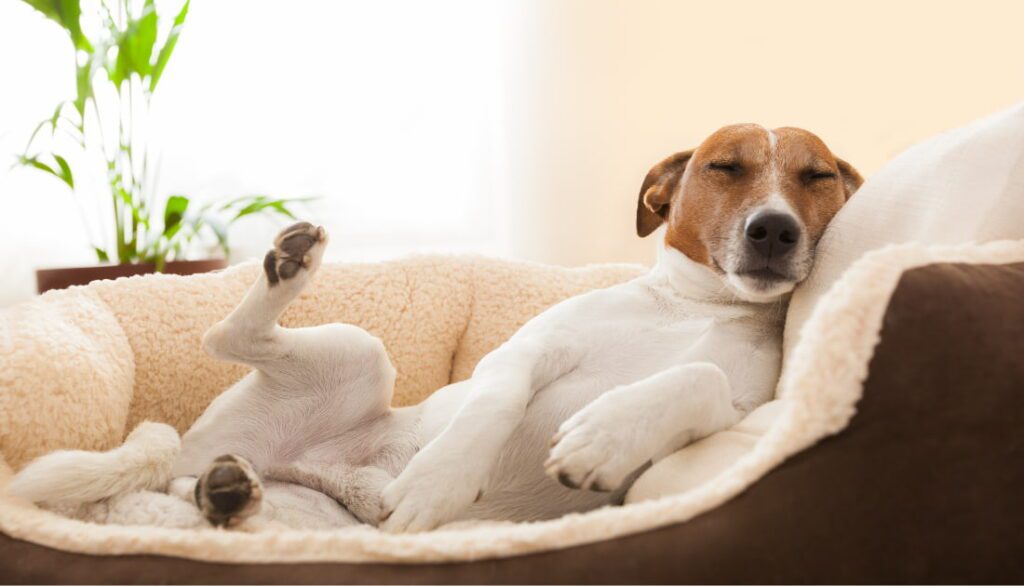
If your dog avoids their bed, it isn’t an act of stubbornness. Their behavior is often a sign that something about the setup isn’t working for them. With patience and a few thoughtful adjustments, you can help your dog discover a resting spot that feels safe, inviting, and actually theirs.
What to Do Tonight
Before buying a replacement, watch where your dog chooses to rest and move their bed there. Add a familiar scent, like a favorite blanket or worn t-shirt, for extra comfort. If the bed still doesn’t match how your dog likes to sleep, the breakdown above can help you pinpoint why. For most dogs, a good setup is one that works with their natural sleep habits, not against them.