You probably spent weeks researching the best food for your dog’s coat, the sturdiest leash for their walks, and the most engaging toys to stimulate their mind. But have you dedicated the same level of thought to where they spend 12 to 14 hours of their day?
A bed isn’t just a plush accessory; it plays a central role in your dog’s physical health and emotional well-being.
Whether you’re raising a high-energy puppy or supporting an arthritic senior dog, your dog’s sleep quality significantly influences their daily behavior, long-term joint health, and emotional stability.
How to Use This Guide
With options ranging from orthopedic memory foam to temperature-regulating beds, choosing the right dog bed can feel surprisingly complex. But don’t worry, this guide is designed to make the process clear and straightforward.
It will walk you through:
- The “Why”: Understanding the primal den instinct that drives your dog’s sleep habits.
- The “What”: A breakdown of every bed type, from human-sized dog beds to sustainable eco-fabrics.
- The “How”: Practical advice on sizing, placement, and the “Floor Test” for maintenance.
From solving specific behavioral problems like bed-chewing to simply ensuring your dog gets restful sleep, this guide will help you navigate an increasingly crowded market and find the right fit.
Section 1: Why Your Dog Needs a Bed
Many dog owners think that since dogs can sleep anywhere — on the floor, on a rug, or at your feet — they should be allowed to do so. But understanding why a bed is essential starts by examining a dog’s history and anatomy.
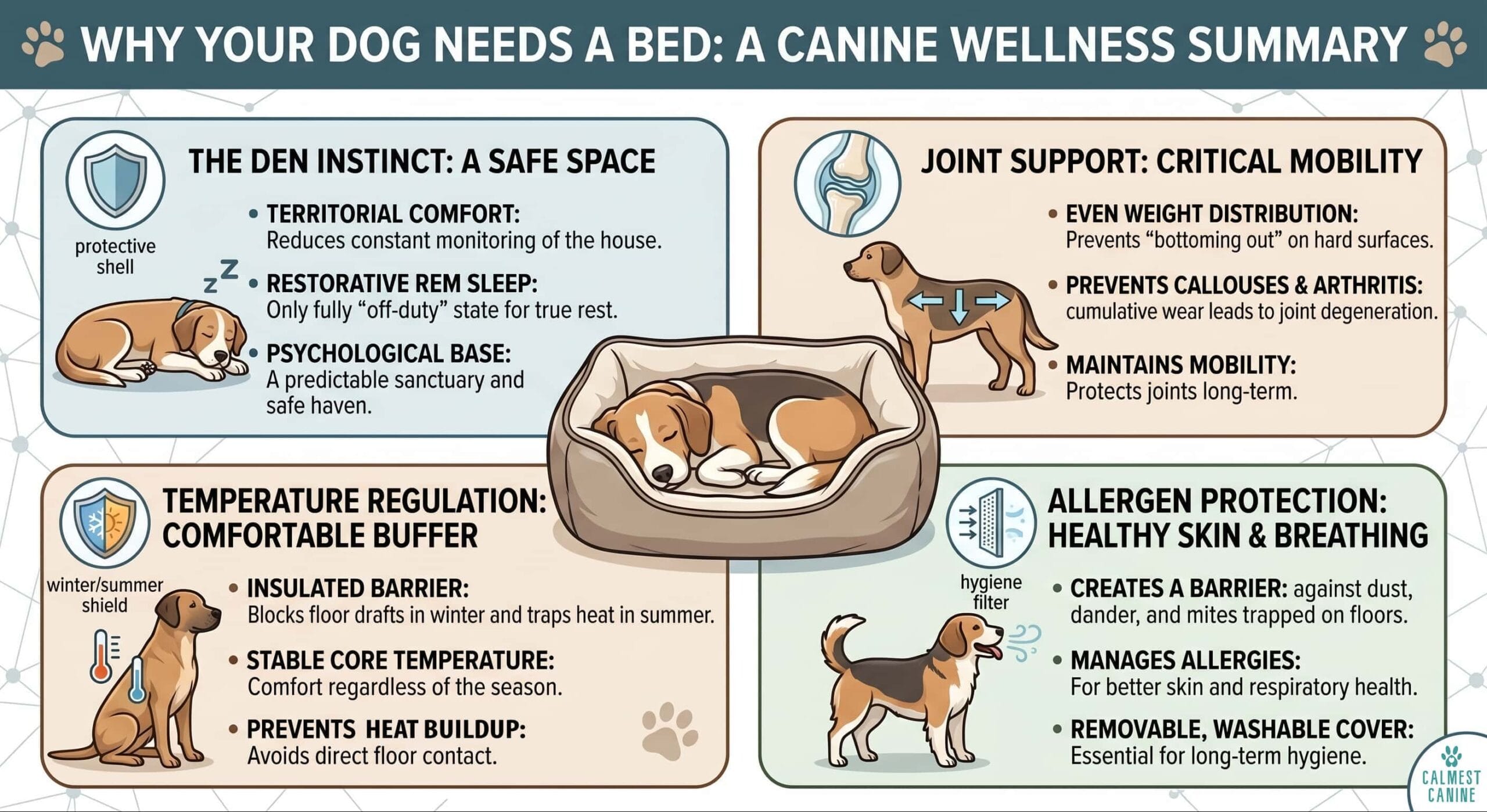
The Den Instinct: A Defined Space of Their Own
Dogs are natural den animals. In the wild, a den is their sanctuary: a small, enclosed, and predictable space where they can rest without having to stay on alert. Even the most pampered house pet retains this instinct.
To your dog, a dedicated bed creates a clear boundary that says, ‘This space is yours.’ That sense of ownership and security helps them fully relax, leading to much more restful, uninterrupted sleep.
Physical Benefits: More Than Just Softness
A quality bed acts as a protective barrier between your dog and the environment by providing:
- Joint Support: Hard surfaces can place pressure on a dog’s hips, shoulders, and elbows over time. A supportive bed helps distribute your dog’s weight more evenly, which can reduce strain on joints and support long-term mobility.
- Temperature Regulation: Floors can be drafty in the winter and trap heat in the summer. Good dog beds are designed to provide insulation, keeping your dog’s core temperature stable year-round.
- Allergen Protection: Carpets and floors trap dust, dander, and mites. A bed with a washable cover functions as a hygienic barrier that helps to manage skin allergies and respiratory health.
Psychological Benefits: Security and Comfort
Beyond physical support, a bed can anchor your dog emotionally. For anxiety-prone dogs, the bed becomes their safe retreat.
Whether the vacuum cleaner is running or new guests arrive, having a familiar, scent-rich place to settle helps your dog feel calmer, providing comfort in an often chaotic household.
Behavioral Benefits: When Your Dog Sleeps Well
When you combine the effects that a high-quality dog bed has on physical support, den security, and emotional calm, the positive results often show up quickly. Dogs with access to a quality bed often display:
- Less Restlessness: They spend less time “nesting,” pacing, or constantly shifting to find a comfortable position.
- More Confidence: They feel more secure in their environment by having a dedicated, safe retreat to call their own.
- Less Stiffness: Especially as dogs age, sleeping on a supportive bed rather than a hard floor leads to a more energetic step and less stiffness or pain in the morning.
Section 2: Types of Dog Beds
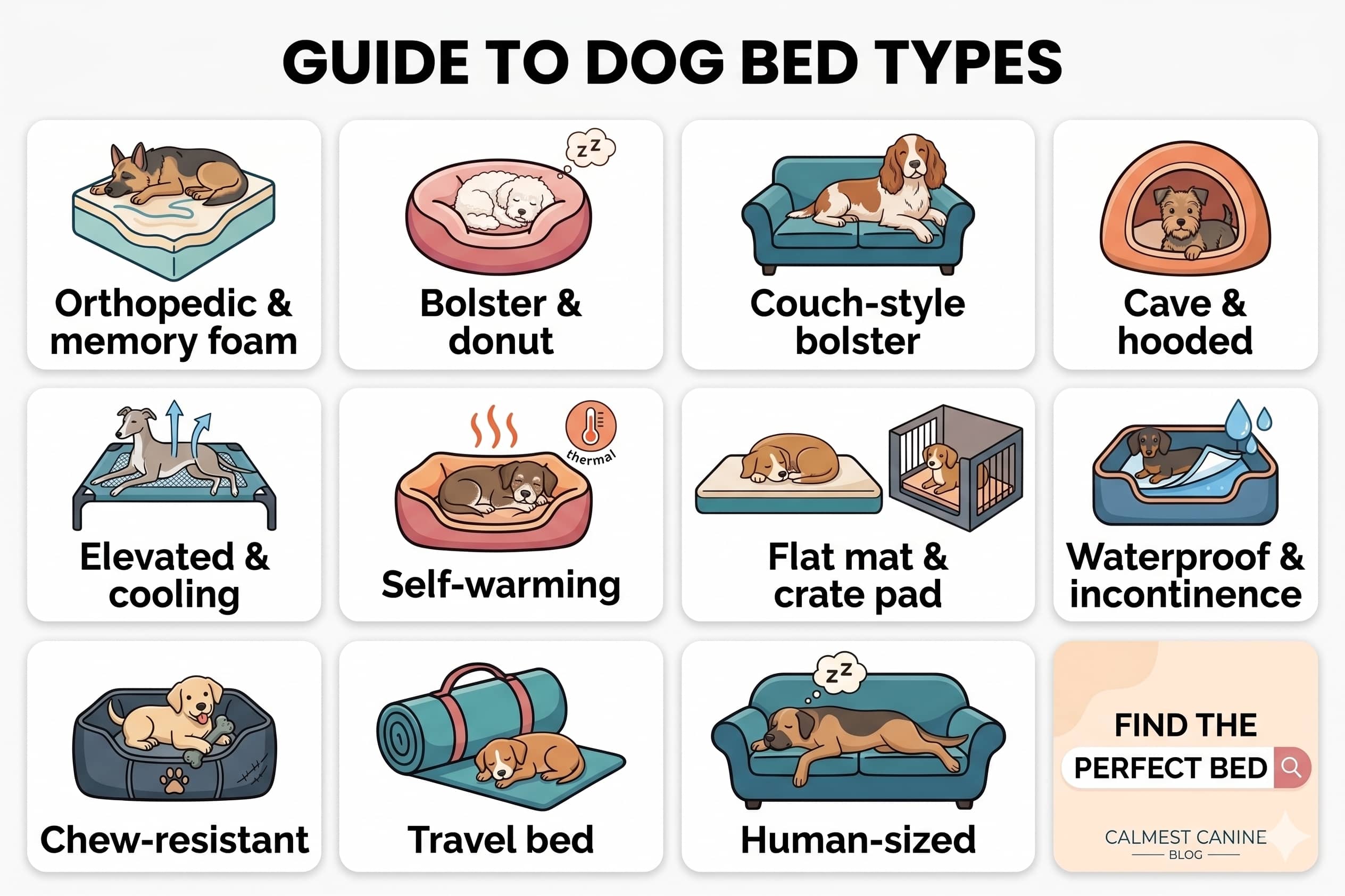
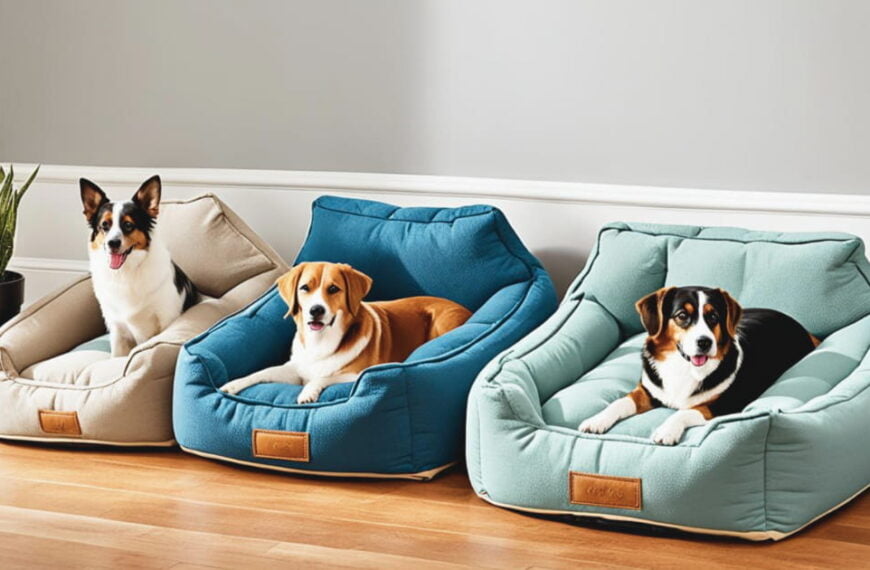
No dog bed is perfect for every dog; what matters is finding the type that best matches your dog’s unique needs. With so many options available today, the breakdown below will walk you through each dog bed type, who it’s designed for, and what it does best.
Orthopedic and Memory Foam Beds
- Who they’re for: Senior dogs, large or giant breeds, and dogs recovering from surgery.
These beds feature high-density memory foam — the same material found in quality human mattresses. Not only does the foam contour to your dog’s body, but also, unlike cheap fiber-fill, it maintains its shape over time without flattening out.
- The Benefit: Orthopedic foam relieves pressure on aching joints and helps maintain spinal alignment, making it especially beneficial for breeds prone to hip dysplasia or arthritis.
Bolster and Donut Beds
- Who they’re for: Dogs that like to curl up, lean, or need extra comfort when feeling anxious.
Bolster beds feature a flat mattress wrapped by three raised, cushioned walls, while donut beds are completely circular, ultra-plush, and shaggy all the way around.
- The Benefit: The raised bolster edges act as a built-in pillow for dogs that like to rest their heads, while the donut’s nest-like design provides a deep sense of security for anxious dogs, making them feel protected from all sides.
Sofa Dog Beds
- Who they’re for: Medium and large breeds that enjoy surveying their environment while resting.
Modeled after a miniature living room couch, these beds feature a supportive backrest and armrests on three sides, leaving the front edge flat and open for easy access.
- The Benefit: The open front allows large dogs to stretch out fully, while the raised edges offer a sturdy headrest and adequate spine support.
Cave and Hooded Beds
- Who they’re for: Burrowers and small, short-coated breeds like Terriers, Dachshunds, Chihuahuas.
These beds come with a built-in roof or a heavy blanket-like flap for the dog to crawl under.
- The Benefit: Cave beds offer a dark, cozy space that mimics a natural underground den, making them perfect for dogs who like to burrow or stay warm.
Elevated and Cooling Beds
- Who they’re for: Heavy-coated and double-coated breeds like Huskies, Malamutes and Goldens, as well as outdoor nappers.
Elevated beds have a cot-style frame with taut mesh fabric stretched across it for airflow, while cooling beds often feature pressure-activated, non-toxic gel inserts to dissipate heat.
- The Benefit: By lifting the dog off the ground, elevated beds provide 360-degree airflow, preventing hot spots from developing under a sleeping dog. Cooling beds with gel-infused foam go a step further, actively drawing heat away from the body rather than simply allowing it to escape.
Self-Warming Beds
- Who they’re for: Toy breeds, short-coated dogs, lean breeds like Greyhounds and Whippets, and senior dogs.
These beds use reflective thermal technology that captures and bounces the dog’s own natural body heat right back to them.
- The Benefit: They provide consistent warmth without requiring electricity. This eliminates the fire or chew risks associated with heated pads, making them a safer option for unsupervised dogs.
Flat Mats and Crate Pads
- Who they’re for: Sprawlers, travel days, and puppies currently undergoing crate training.
These are thin, rectangular pads designed to fit standard crate sizes or serve as placemats during training.
- The Benefit: These pads provide insulation and support in crates or during training without taking up unnecessary space.
Waterproof and Incontinence Beds
- Who they’re for: Senior dogs managing bladder leaks, puppies in potty training, and muddy outdoor dogs.
These beds have a waterproof inner liner beneath a removable, washable outer cover.
- The Benefit: They protect the foam core from moisture damage and bacterial buildup, extending the bed’s lifespan and making cleanup easier.
Chew-Resistant Beds
- Who they’re for: Aggressive nesters, teething puppies, and dogs prone to boredom chewing.
Constructed from ballistic nylon with reinforced seams and hidden zippers, these beds are designed to withstand biting and scratching.
- The Benefit: These beds break the frustrating buy-shred-replace cycle by using tough materials and removing loose tags, corners, and exposed fluff that invite destructive chewing (though no bed is 100% indestructible).
Travel Beds
- Who they’re for: Camping dogs, road-trippers, and frequent hotel travelers.
These lightweight and compressible beds roll up or fold into a carrying case for travel.
- The Benefit: They provide a familiar scent and consistent comfort for campsites or hotels, reducing travel-related stress.
The Human-Sized Dog Bed (The 2026 Viral Trend)
- Who they’re for: Social sleepers and owners who enjoy resting with their pets.
The standout trend of 2026 is the oversized lounger designed for both humans and dogs to share.
- The Benefit: They foster bonding between you and your dog while offering furniture-grade orthopedic foam and high-quality faux fur, becoming a genuine lifestyle addition for the right household.
Quick Comparison: Bed Type by Personality
The table below is a useful starting point for matching your dog’s personality to their most likely bed type, but personality alone doesn’t tell the whole story. Size, sleep style, and health needs all play an equally important role, and the sections ahead will walk you through each one.
| Dog Personality | Primary Need | Best Bed Type |
|---|---|---|
| The “Senior Citizen” | Joint Relief | Orthopedic Memory Foam |
| The “Security Guard” | Visibility & Safety | Bolster Bed |
| The “Burrower” | Privacy | Cave/Hooded Bed |
| The “Hot Sleeper” | Airflow | Elevated/Cooling Bed |
| The “Night Owl” | Warmth | Self-Warming Bed |
| The “Couch Potato” | Sprawl Space | Sofa Dog Bed |
| The “Accident Prone” | Easy Cleanup | Waterproof Bed |
| The “Destroyer” | Durability | Chew-Resistant Bed |
| The “Adventurer” | Portability | Travel Bed |
| The “Social Butterfly” | Connection | Human-Sized Dog Bed |
Section 3: How to Choose the Right Dog Bed
Choosing the right bed for your dog goes beyond finding a cute pattern. To find the perfect match, you need to consider your dog’s measurements, biological needs, and the safety of the materials themselves.
Size: How to Measure Your Dog Correctly
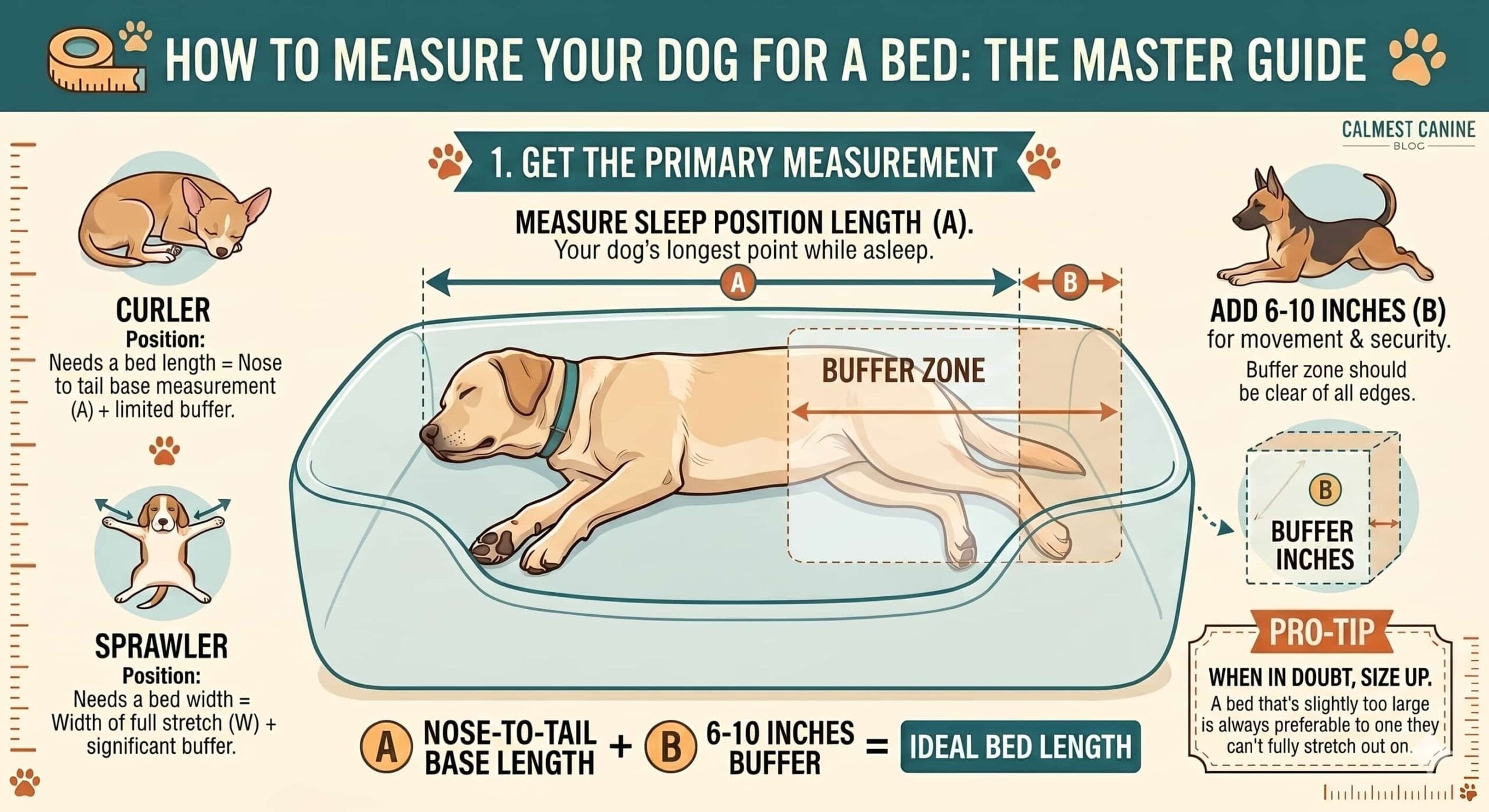
When measuring your dog for a bed, don’t rely on weight alone; it doesn’t accurately reflect how much space they actually take up when sleeping. To get the right fit, follow these two steps:
- The Rule of Thumb: Measure your dog from the tip of their nose to the base of their tail while they are in their preferred sleeping position.
- The Buffer: Add 6 to 10 inches to that measurement to ensure they don’t hang off the edge.
If your dog tends to switch between curling up and sprawling out, always choose a bed size that accommodates the sprawl. A slightly larger bed is preferable to one that is too small for them to stretch out comfortably.
Age and Life Stage
A dog’s biological needs shift dramatically as they grow, meaning a mattress that protects a growing puppy is entirely different from the support required by an aging senior. To keep your dog comfortable at every stage, look for these key features:
- Puppies: Focus on chew-resistance and washability. Anyone who has raised a teething puppy knows that a standard plush cover won’t last a week. A waterproof inner liner is also essential during the potty-training phase to prevent permanent core odors.
- Adults: Choose beds that balance durability with comfort. Look for high-density fills that hold their shape through active nesting, digging, and frequent washing.
- Seniors: Orthopedic joint support becomes the top priority. Look for low-profile beds that require minimal effort to enter, which are ideal for dogs managing stiff hips and limited mobility.
For a deeper breakdown by life stage, see Section 9: Dog Beds by Life Stage.
Sleep Style: How Does Your Dog Dream?
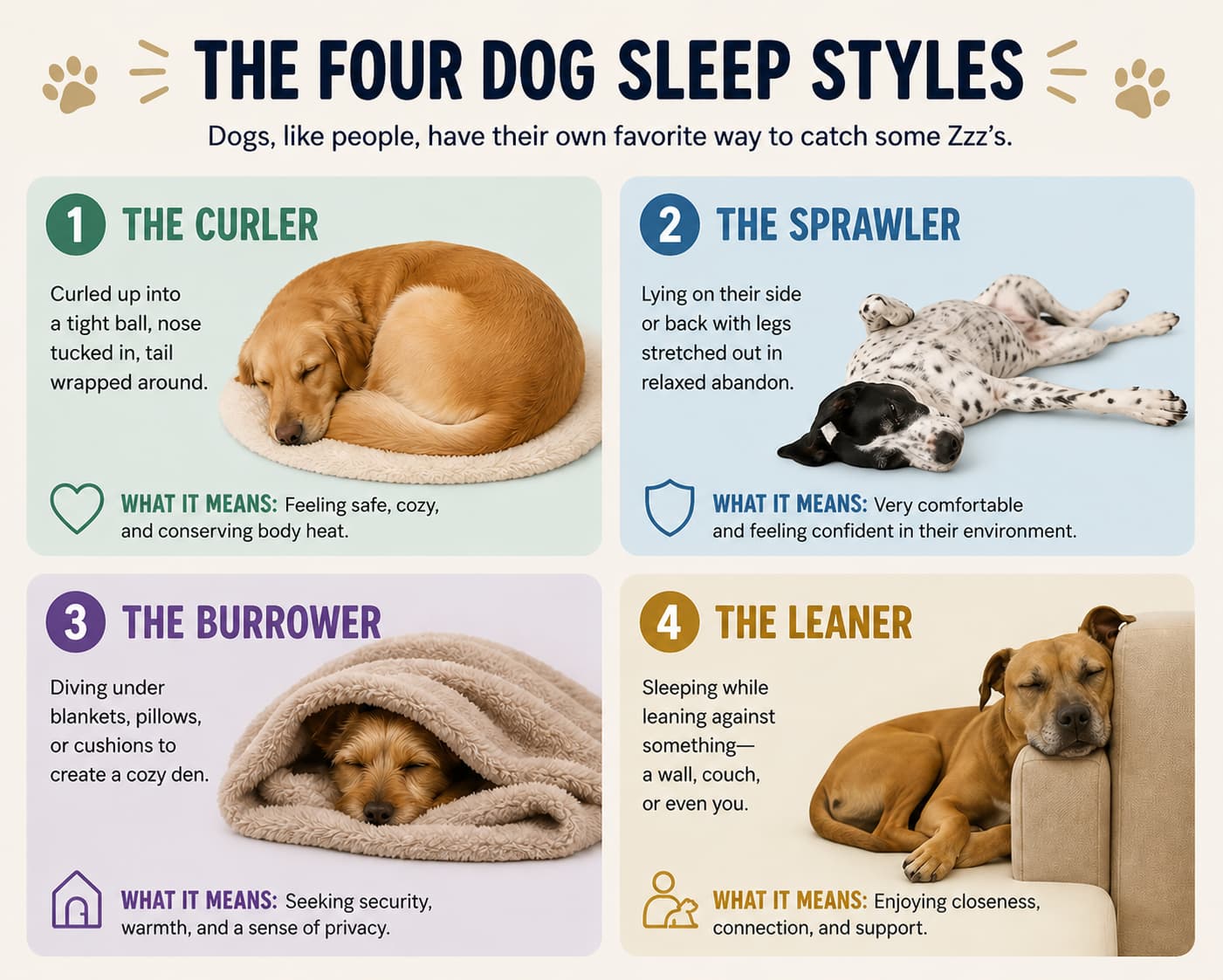
Now that you’ve taken your dog’s size and life stage into account, the next major factor to consider is the actual shape of the bed.
Before buying, spend a night or two watching how your dog sleeps. Their natural sleep position is one of the most reliable guides to the right bed shape, and most dogs fall consistently into one of these four styles:
- The Curler: Tucks their chin to their tail and sleeps in a tight, compact circle to conserve body heat and feel protected. They do best with a snug donut bed or deeply cushioned bolster bed.
- The Sprawler: Lies flat on their side or belly with all four legs stretched straight out, requiring lots of surface area. They prefer the ample space of a flat mattress, large mats, or the open front of a sofa-style bed.
- The Burrower: Instinctively digs, scratches, and tunnels underneath blankets or cushions to create a dark, warm, hidden space. They thrive in the enclosed environment of a cave or a hooded bed.
- The Leaner: Prefers to sleep with their head or spine propped against a raised surface, letting their body sprawl outward. They need a sturdy, structural headrest like those found on sofa-style or bolster beds.
Health and Behavioral Conditions
Beyond size, life stage, and sleep style, your dog’s health and behavioral history should also shape your choice. If your dog manages any of the following conditions, the bed’s design should directly address those needs — not just general comfort.
- Anxiety: Prioritize calming donut beds with deep walls or plush faux-fur that mimic the comfort of sleeping next to a littermate.
- Incontinence: Look for dual-layer waterproofing — a waterproof inner liner to protect the foam core, paired with a quick-drying, removable cover.
- Skin allergies: Choose hypoallergenic, chemical-free materials with third-party certifications (like OEKO-TEX®) to avoid triggering skin reactions or irritation.
- Arthritis, chewing, or breed-specific needs: These conditions require more targeted solutions. To learn more, see Section 10: Dog Beds for Special Needs.
Fine-Tuning Your Choice
Once you’ve identified the right bed type for your dog’s size, sleep style, and health needs, these additional considerations can help you refine your final choice.
Climate and Temperature
Pay close attention to how your dog behaves at night. If they frequently move from their bed to the cold floor and back, their bed is likely trapping too much heat — or vice versa, if they avoid the floor entirely and burrow deeper into their bed, they may not be warm enough.
- Cooling Options: For thick or double-coated breeds and hot summer months, look for elevated mesh cot-style beds that allow 360-degree airflow underneath, or pressure-activated gel-infused foam that dissipates heat rather than retaining it.
- Warming Options: For toy breeds, short-coated dogs, or cold climates, self-warming beds use an internal thermal reflective layer to reflect your dog’s natural body heat back toward them without the risks associated with plug-in heating pads.
Third-party Safety Certifications
Temperature is only one factor to consider. The safety of the materials themselves is just as critical.
Don’t just take a manufacturer’s word for it. The most trustworthy dog beds carry independent, third-party certifications that verify exactly what goes into the products your dog breathes and sleeps on every night. Look for these key labels:


- CertiPUR-US®: Certifies that the foam is made without ozone-depleting chemicals, heavy metals, or formaldehyde.
- OEKO-TEX®: Guarantees that every fabric component (down to the thread and zippers) has been tested for harmful substances.
Sustainability: Eco-Friendly Choices
More dog owners are factoring sustainability into their purchasing decisions, and the dog bed market has responded with a growing range of eco-friendly materials worth considering.
- Recycled Ocean Plastics: Many premium fillers are made from repurposed plastic bottles, helping reduce landfill and ocean waste.
- Organic Materials: Look for sustainable hemp or GOTS-certified organic cotton (the Global Organic Textile Standard), which is the most rigorous certification for organic fibers.
A note of caution: Look for third-party certifications rather than relying solely on brand claims. Be cautious of greenwashing in the pet industry. A bed marketed as “eco-friendly” must have verifiable certifications to support that claim.
Smart and Tech-Enabled Beds
At the other end of the spectrum from eco-friendly materials sits a newer category entirely: smart, tech-enabled beds designed to actively monitor and regulate your dog’s comfort.
- Sleep Tracking: Some beds now have built-in sensors that monitor your dog’s heart rate and restlessness, sending the data directly to your phone — a helpful feature for dogs with health conditions.
- Active Temperature Regulation: High-tech beds can automatically heat or cool based on your dog’s body temperature, taking the guesswork out of seasonal comfort.
Across all the factors covered in this section, from size and sleep style to health needs, climate, certifications, and technology, the best bed is simply the one that meets your dog’s specific needs today.
Section 4: How Many Dog Beds Does Your Dog Need
It’s a common sight: a perfectly good bed sitting untouched in the corner while the dog naps on a pile of laundry in the bedroom.
This happens because many owners fall for the “One Bed Myth”: the belief that a dog only needs a single designated sleeping spot.
The “One Bed Myth”
In reality, your dog’s needs change throughout the day. They may want to be social and keep watch in the living room during the morning but crave deep, secluded privacy in the evening.
If you only provide one bed, you force your dog to choose between physical comfort and their psychological need to be near the family. Depending on your home’s layout, figuring out how many dog beds your dog should have requires looking at their daily routine.
Room-by-Room Breakdown
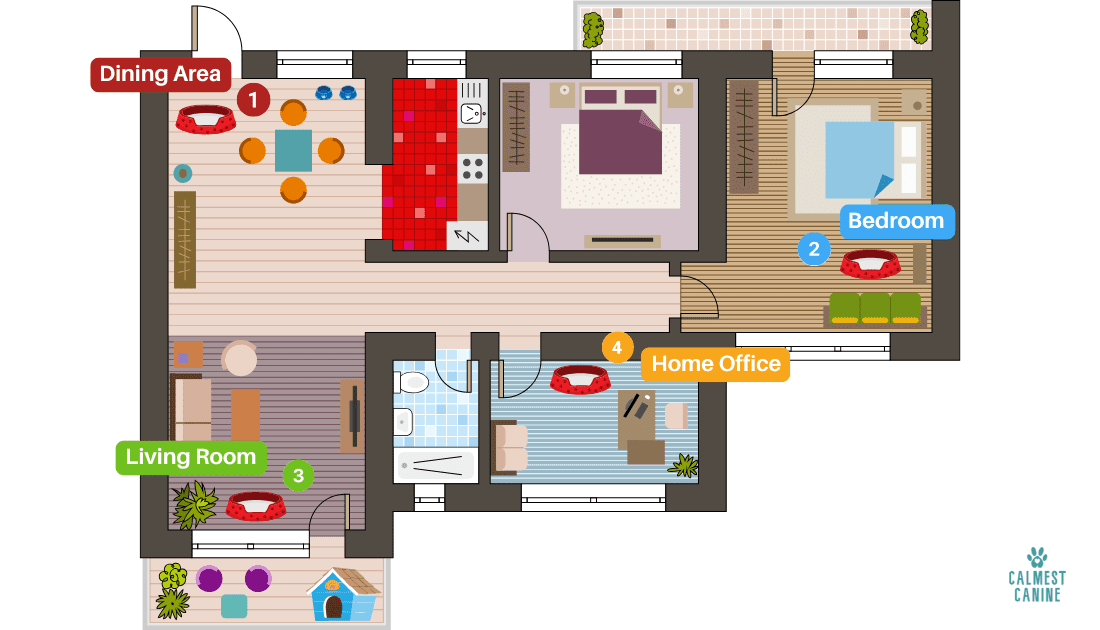
The easiest way to think about how many beds your dog needs is to think about how they actually move through your home. Most dogs naturally use three zones:
- The Social Zone (Living Room & Dining Area): This is where your dog wants to be part of the action without being underfoot. A bolster or lounger bed here allows them to stay connected to the family without competing for couch space.
- The Sanctuary Zone (Bedroom/Crate): This is where deep, uninterrupted sleep happens. A high-quality orthopedic or cave bed here supports the restorative REM sleep your dog needs.
- The Work Zone (Home Office): A simple mat or flat bed gives your dog a designated place to settle near you without disrupting your workflow.
Life Stage Recommendations
Now that we’ve covered the primary zones in your home, your dog’s age acts as the final modifier to determine your exact bed count. A dog’s spatial needs and physical vulnerabilities shift over time, requiring a different strategy at each stage.
- Puppies: Start with more, not less. Place mats in every room to help with potty training and teach your puppy that every room has a designated spot for settling down.
- Adults: Most adult dogs naturally find their two or three favorite spots. Focus your investment on high-quality beds in those specific areas rather than spreading the budget thin across every room.
- Seniors: Mobility is the priority. Since it may be painful for a senior dog to walk across the house, a supportive orthopedic bed in every room they frequent is a kindness that protects their joints and preserves their independence.
| Life Stage | Recommended Beds | Best Bed Type |
|---|---|---|
| Puppy (0–2 yrs) | 2–3 | Durable/chew-resistant beds |
| Adult (2–7 yrs) | 2+ | Comfort or activity-specific beds |
| Senior (7+ yrs) | 3+ | Orthopedic or memory foam beds |
Regardless of your dog’s life stage, the core principle remains the same: your dog’s bed count should reflect their daily movement through your home, not your preference for a tidy living room.
The “Plus One” Rule for Multi-Dog Households
For households with more than one dog, there is one additional rule worth knowing. Even if your dogs are best friends who love to cuddle, always follow the “Plus One Rule”: one bed for every dog, plus one extra.
💡 Why the “plus one”?
This prevents resource guarding. Having an extra bed ensures that no dog ever feels pushed out of a comfortable spot, reducing tension and late-night scuffles over who gets the best bed.
Section 5: Where to Put Your Dog’s Bed
Choosing the right bed matters, but placing it in the wrong spot can turn an expensive purchase into a piece of furniture your dog completely ignores. To find the perfect location for your dog’s bed, think like a den-dweller.
Why Location Matters
Dogs instinctively prefer locations with a solid wall behind them and a clear view of the entrance, rather than sitting in the center of an open room.
When placing a bed, you are recreating this same sense of security. Your dog needs to feel that their back is protected before they lower their guard and sleep.
Finding the Right Spot Within Each Room
Understanding which rooms to use is important, but the placement within each room matters just as much. Here are a few principles that apply across all rooms:
- Back against the wall: Place the bed in a corner or against a wall rather than in the center of the room. This gives your dog a protected back and a clear view of the space — the exact conditions a den-dweller instinctively seeks.
- Out of the direct path of foot traffic: Even within a suitable room, a bed placed in a frequently walked area will keep your dog’s nervous system on low-level alert. Aim for a spot that feels slightly removed from the main flow of movement.
Unconventional but Effective Spots
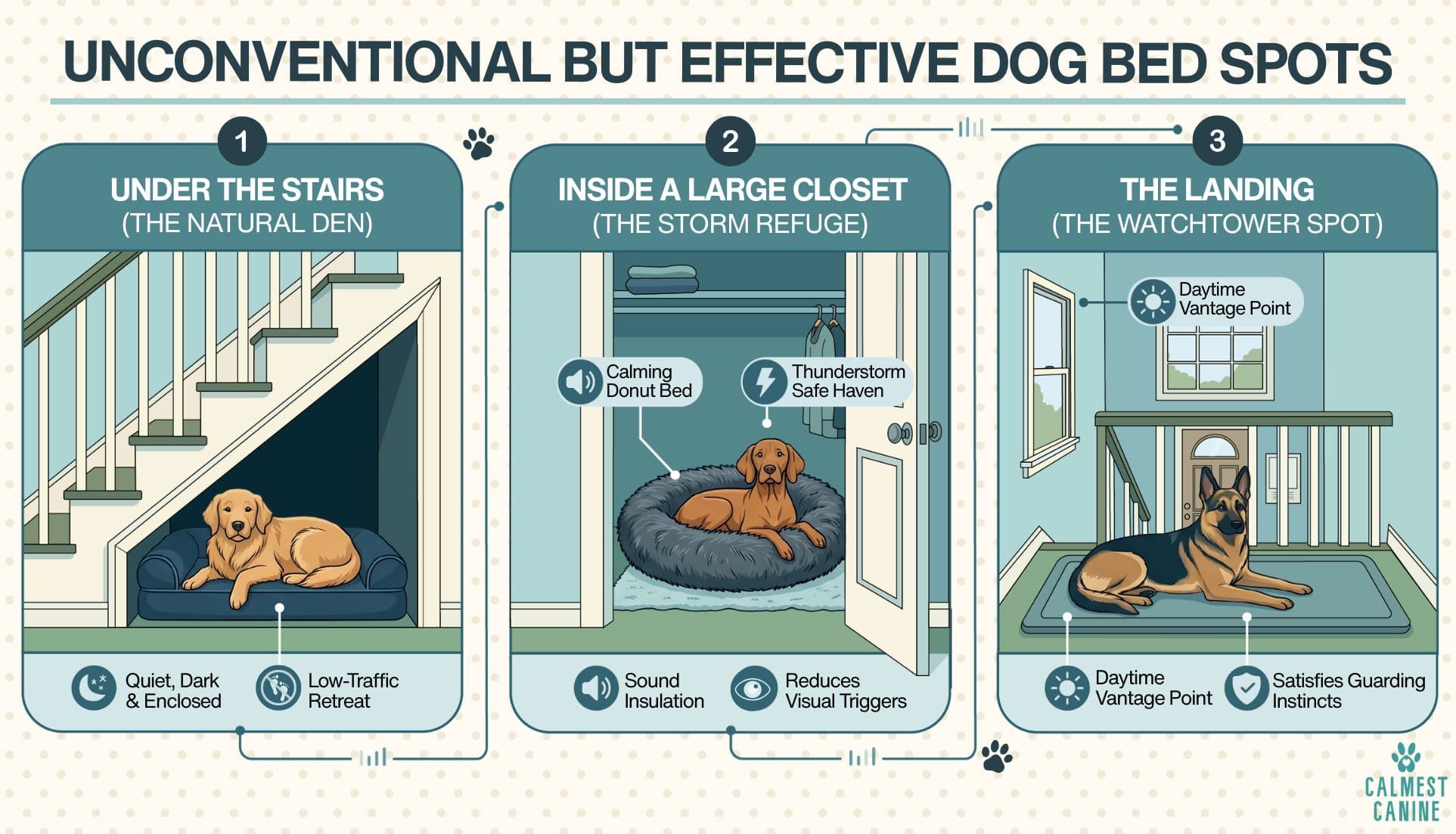
Beyond the living room, bedroom, and home office zones covered earlier, there are locations that are often underused but can be very effective, especially for dogs with anxiety or strong guarding instincts:
- Under the Stairs: If you have an open staircase, the nook underneath can serve as a natural den; it is dark, quiet, and enclosed on three sides. Most dogs will naturally gravitate toward this area once a bed is placed there.
- Inside a Large Closet: For highly anxious dogs or during intense thunderstorms, placing a bed in the back of a quiet walk-in closet with the door left open provides significant sound insulation. Many owners report this as a game-changer for noise-sensitive dogs. Throwing a worn sweatshirt of yours inside the bed adds an extra layer of comforting scent security.
- The Landing: A landing that overlooks the front door can be an ideal daytime spot for a dog that feels the need to keep watch. It satisfies their guardian instinct without putting them in a high-traffic zone.
What to Avoid: The “Red Zones”
Just as the right spot can make a bed irresistible to your dog, the wrong one can make even the most expensive bed completely useless. These are the four locations to avoid:
- Drafts and vents: Avoid placing beds directly in front of AC vents or drafty doorways. Sudden temperature shifts can prevent a dog from settling comfortably.
- High-traffic paths: Never put a bed in a narrow hallway or directly in front of a door. Being constantly stepped over keeps a dog’s nervous system on alert.
- Noise sources: Keep beds away from loud appliances. Washing machines and refrigerators that hum and click throughout the night are persistent sensory triggers.
- Direct heat: Placing a bed too close to a fireplace or radiator can lead to overheating, which can force your dog to abandon the bed for cooler floors. This is especially important for thick-coated breeds that already run warm.
Multi-Dog Placement Strategy
If you have multiple dogs, placement becomes an additional tool for maintaining peace rather than just comfort. If your dogs aren’t natural cuddlers, never place their beds so one dog has to pass through another’s space to access it. This is a common trigger for resource guarding among otherwise compatible dogs.
Choosing the right location costs nothing, but it’s often the difference between a bed your dog genuinely uses and an expensive decoration.
Section 6: How to Get Your Dog to Use Their Bed
It can be frustrating to research the perfect orthopedic mattress, only to have your dog sniff it once and then go right back to sleeping on the hard floor.
But before you take it personally, know that most dogs are neophobic, meaning they’re naturally skeptical of new objects in their territory, so their initial resistance has nothing to do with the bed itself.
Why Dogs Avoid New Beds
A brand-new bed doesn’t just look unfamiliar. It smells unfamiliar too.
Factory-fresh fabrics often carry manufacturing odors that can overwhelm a dog’s sensitive nose, and the new bed lacks the familiar nesting shape your dog has spent months carving into their old one. To your dog, it isn’t a sanctuary yet; it’s an unpredictable intruder.
Fortunately, with a little patience, you can change that perspective. To make the transition seamless, follow these steps for a gradual introduction:
The Bed Introduction Protocol
Most dogs adapt within 3 to 7 days if you follow the steps consistently. Anxious or older dogs may take two to three weeks, so remember: patience in this case is an investment, not a delay.
Cue Words and Routine Building
Teaching your dog a specific bed command takes the guesswork out of settling down and gives them a clear, consistent signal to follow. To turn the new bed into a reliable retreat, implement these behavioral strategies:
- Establish a “Place” Command: Choose a consistent cue, such as “Go to your bed” or “Place,” and reward your dog immediately with a high-value treat when they comply.
- Anchor it to a Daily Routine: Incorporate the cue into your daily routine. For example, only give your dog a goodnight biscuit after they have willingly settled onto their bed. Over time, the cue becomes a reliable signal that tells their nervous system it’s time to relax.
- Protect the Bed’s Integrity: Never use the bed as a time-out spot. If your dog associates the space with punishment, they’ll actively avoid it, undoing all the positive associations built during the introduction process.
Section 7: How to Keep a Dog Bed Clean (and When to Toss It)
A dog bed is one of the most utilized pieces of furniture in your home. It collects dander, outdoor allergens, coat oils, and the occasional accident.
Proper maintenance goes beyond odor control. It helps preserve the bed’s structural integrity and protects your dog’s skin and respiratory health.
How Often Should You Wash a Dog Bed?
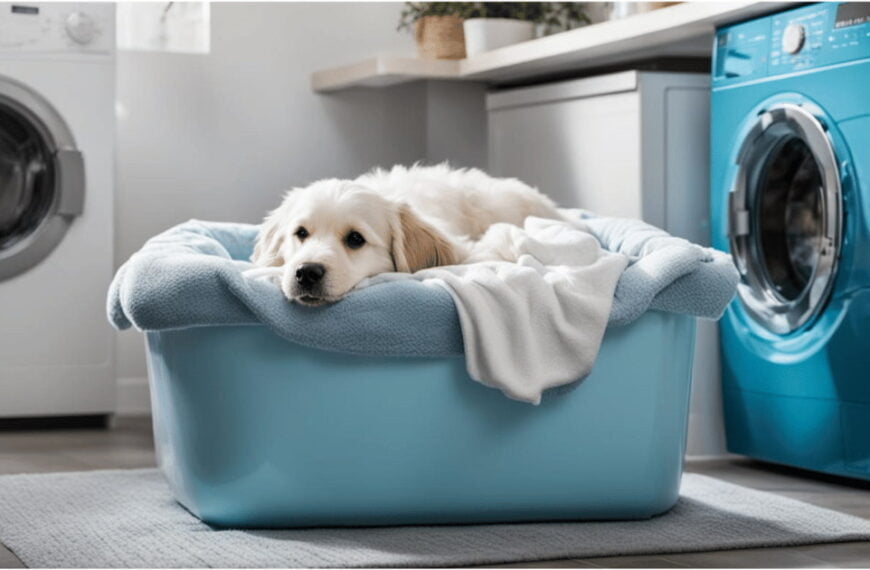
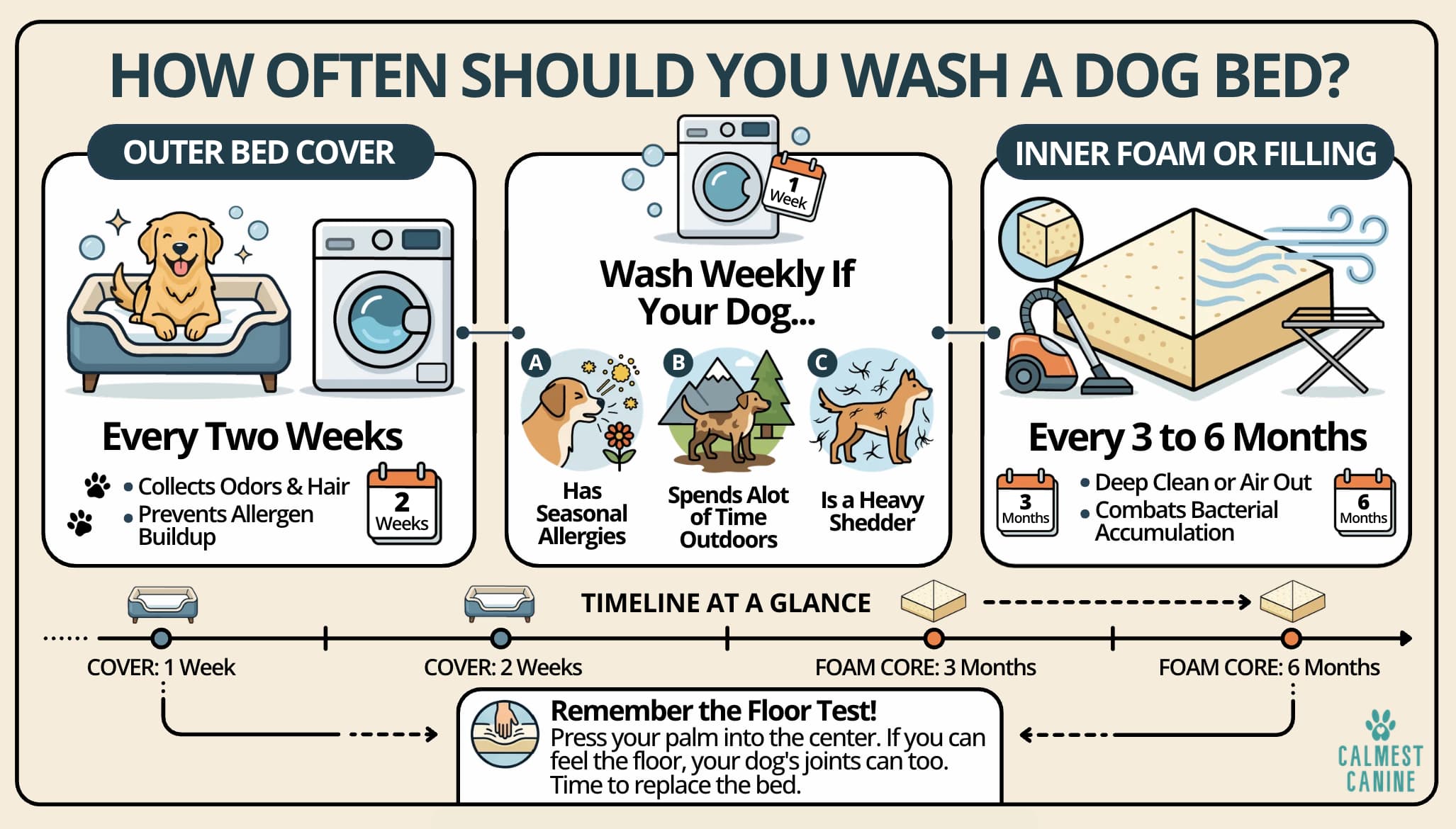
As a general rule, wash the bed cover every two weeks. If your dog has seasonal allergies, spends a lot of time outdoors, or is a heavy shedder, once a week is better. The inner foam or filling should be deep-cleaned or aired out every 3 to 6 months.
Machine vs Hand-Washing
Not every dog bed can be cleaned the same way, and using the wrong method can permanently damage the materials you’re trying to protect.
- Removable covers: Most modern beds feature removable, machine-washable covers. Wash these in cold or lukewarm water on a gentle cycle to prevent shrinkage.
- The stuffing/core: Never put solid memory foam in a washing machine; the agitation will tear it apart. For a full step-by-step process, follow our guide on how to wash a dog bed with stuffing.
- Non-removable covers: If the cover can’t be unzipped or detached, spot-cleaning is your only option. Use a pet-safe enzymatic cleaner and a damp cloth for surface stains and odors.
💡 A note on non-removable covers: Without the ability to fully wash the cover, bacteria and allergens can accumulate over time. If your dog has allergies or frequent accidents, a bed with a removable cover is worth the investment.
Dealing with Stubborn Odors and Stains
When a regular wash isn’t enough, these two methods address odors at the source rather than masking them:
- Baking soda boost: Sprinkle baking soda over the foam or inside the cover, and let it sit for 30 minutes before vacuuming or washing. This neutralizes odor compounds at a chemical level rather than just masking them.
- Enzymatic cleaners: The go-to solution for stubborn odors, urine, and vomit stains. Standard soap won’t break down the proteins, which means your dog will still detect the accident long after you think it’s gone, potentially encouraging repeat incidents in the same spot.
Drying Correctly to Prevent Mold
Once washed, drying correctly is just as important. Moisture is the biggest threat to a dog bed’s longevity. Reassembling a bed with a damp cover or foam that hasn’t fully dried creates the ideal conditions for mold and mildew growth, which no amount of future washing will fully reverse.
- Always tumble-dry covers on low heat or line-dry them completely before reassembling. Rushing this step risks trapping moisture inside the cover, defeating the purpose of the deep clean.
- Allow the solid foam core 24 to 48 hours to air-dry completely. To test it, press your palm firmly into the center. If the material feels even slightly cool or damp, moisture is still trapped inside and it needs more time.
When to Replace Rather Than Wash
Sometimes, no amount of cleaning can restore a dog bed. Knowing when to replace rather than rewash protects your dog’s joint health because a clean but structurally failed bed offers no more support than sleeping on the floor. To check, perform the Floor Test.
🔍 The Floor Test: Your 5-Second Quality Check
Press your palm firmly into the center of the bed — specifically where the heaviest part of your dog’s torso rests. If you can feel the hard floor underneath, the support has failed.
If your hand can feel the floor, your dog’s joints are feeling it too. At that point, the bed has become little more than a thin piece of fabric, and no matter how fresh it smells after a wash, it’s time for a replacement.
Other Signs the Bed is Past its Prime
Beyond the Floor Test, watch for these three additional signs:
- Persistent odor: If the bed still smells sour immediately after a deep clean, bacteria have likely penetrated the foam core, and surface cleaning won’t resolve it.
- Permanent lumps: If the fiber-fill has clumped into hard, uneven masses that won’t fluff back up, this creates pressure points rather than distributing weight, which is the opposite of what a supportive bed should do.
- Visible wear: Frayed seams or thinning fabric can become a safety hazard. Dogs naturally investigate loose threads, and swallowing stuffing or fabric fragments can cause a serious internal blockage. It’s an easy risk to prevent by replacing the bed before it deteriorates that far.
Section 8: Common Dog Bed Problems (and How to Fix Them)
Even with the highest-rated orthopedic bed placed perfectly in your home, you may still encounter a few common problems.
In almost every case, a problem with a dog bed is a communication issue. Your dog is telling you something about the bed, the location, or their emotional state. The solution is usually more straightforward than it seems.
| The Problem | What Your Dog Is Communicating | The Immediate Fix |
|---|---|---|
| My Dog Chews Their Bed | Boredom, teething, or displacement anxiety. They are redirecting emotional tension or pent-up physical energy onto the closest soft object. | Upgrade and redirect. Switch to a bed made from ballistic nylon with hidden zippers. At the same time, provide high-value chew toys (like a stuffed, frozen KONG) to safely redirect that chewing instinct. |
| My Dog Pees on Their Bed | A medical issue, a house-training lapse, or stress caused by a sudden change in the household environment. It is never an act of spite or anger. | Rule out health first, then neutralize. Consult your vet to rule out a UTI. Clean the bed with an enzymatic cleaner; standard soap won’t break down the proteins, and if your dog can still trace the scent signature, they will return to it. If, instead, your dog is peeing on your bed, the underlying causes can be quite different — see our guide on why your dog is peeing on your bed. |
| My Dog Won’t Use Their Bed | A sensory flaw, a spatial trap, or a negative association that makes the bed feel unsafe or uncomfortably warm. | Audit the environment. Check for factory chemical scents, crinkly liners, or hidden drafts. For our comprehensive checklist and step-by-step introduction roadmap, revisit Section 6. |
| My Dog Falls Off Their Bed | A mismatch in size or a complete lack of boundaries to keep them centered during active REM dream cycles. | Add boundaries and traction. Upgrade to a bolster bed with raised edges to cradle them as they move. Ensure the bed has a non-slip base; frequently, dogs “fall off” simply because the mattress slides across slick floors when they shift weight. |
| My Dog Drags Their Bed Around | A desire for proximity or predatory play. They are either moving their safe zone closer to you, or treating the bed like prey (shaking and thrashing it). | Apply the Plus One Rule. If they are dragging it to be near you, add a second bed to that specific room. If they are thrashing it, replace it with a bed featuring reinforced seams before you face a “stuffing explosion. |
Why does my dog pee on their bed?
Dogs usually pee on their beds due to a urinary tract infection (UTI), a house-training setback, or stress—not spite. If the behavior is sudden or repeated, schedule a vet visit to rule out a medical cause. Always clean the area with an enzymatic cleaner to fully remove the scent, and check out our guide on why your dog is peeing on your bed for a deeper look at behavioral triggers.
Why is my dog chewing their bed?
Dogs chew their beds due to puppy teething, boredom, or separation anxiety. Choosing a durable bed with reinforced seams can prevent damage, and redirecting the behavior with a high-value chew toy like a stuffed KONG gives your dog an appropriate outlet. For a full breakdown on breaking this habit, read our guide on how to stop your dog from chewing their bed.
Section 9: Dog Beds by Life Stage
Just as humans don’t sleep in cribs forever, a dog’s bedding needs to change as they grow. To ensure your dog is always getting the best possible rest, matching their bed to their current life stage is one of the most overlooked ways to support their long-term health.
Puppies: The “Destructible” Phase (Ages 0–2 Years)
When buying a bed for a puppy, you aren’t looking for a “forever bed”—you’re looking for a durable training tool that can survive the chaos of early life.
- Chew-Resistant Durability: Reinforced seams and rip-stop fabrics (like ballistic nylon) that can handle sharp puppy teeth without coming apart at the first tug.
- Crate Compatibility: A flat mat or crate pad is often better than a plush bolster bed during house-training, as it provides comfort without inviting accidents.
- Waterproof Inner Liners: Accidents are inevitable. A waterproof liner is non-negotiable to prevent odors from soaking deep into the core foam.
Adult Dogs: The Comfort & Lifestyle Phase (Ages 2–7 Years)
Once a dog reaches adulthood, their personality and activity levels are well-established. This is the time to invest in a quality bed that matches their lifestyle.
- Activity-Based Support: High-energy working dogs need a firm orthopedic surface to recover, while sedentary breeds might prioritize a plush donut bed.
- The Style Era: Since adult dogs are generally past the destructive chewing phase, you can safely choose a bed that complements your home’s interior design.
- Proper Sizing: Adult dogs are fully grown, making this the right time to get sizing right. A bed that’s too small forces your dog to curl uncomfortably, while one that’s too large reduces the feeling of security.
Senior Dogs: The Medical Support Phase (Ages 7+ Years)
For senior dogs, their bed becomes a crucial piece of medical equipment. Your choices directly impact their daily comfort, pain management, and mobility.
- Solid Orthopedic Memory Foam: High-density solid foam is the only material that adequately supports aching joints. Avoid shredded foam, which compresses unevenly.
- Low-Profile Accessibility: High bolsters are a tripping hazard for limited mobility. Look for low-profile or open-front designs so they don’t have to lift their paws high.
- Incontinence Management: Age-related leaking happens. A removable, machine-washable, medical-grade waterproof cover ensures easy, hygienic maintenance.
Revisiting your dog’s bed every few years is a small habit that pays off in long-term comfort and health.
Section 10: Dog Beds for Special Needs
While Section 9 covered the needs of dogs at different life stages, this section addresses specific medical and behavioral conditions that require a more targeted approach, regardless of age.
Anxious Dogs: Creating a Safe Haven
Anxiety in dogs often stems from a sense of exposure, meaning they need to feel secure to truly relax.
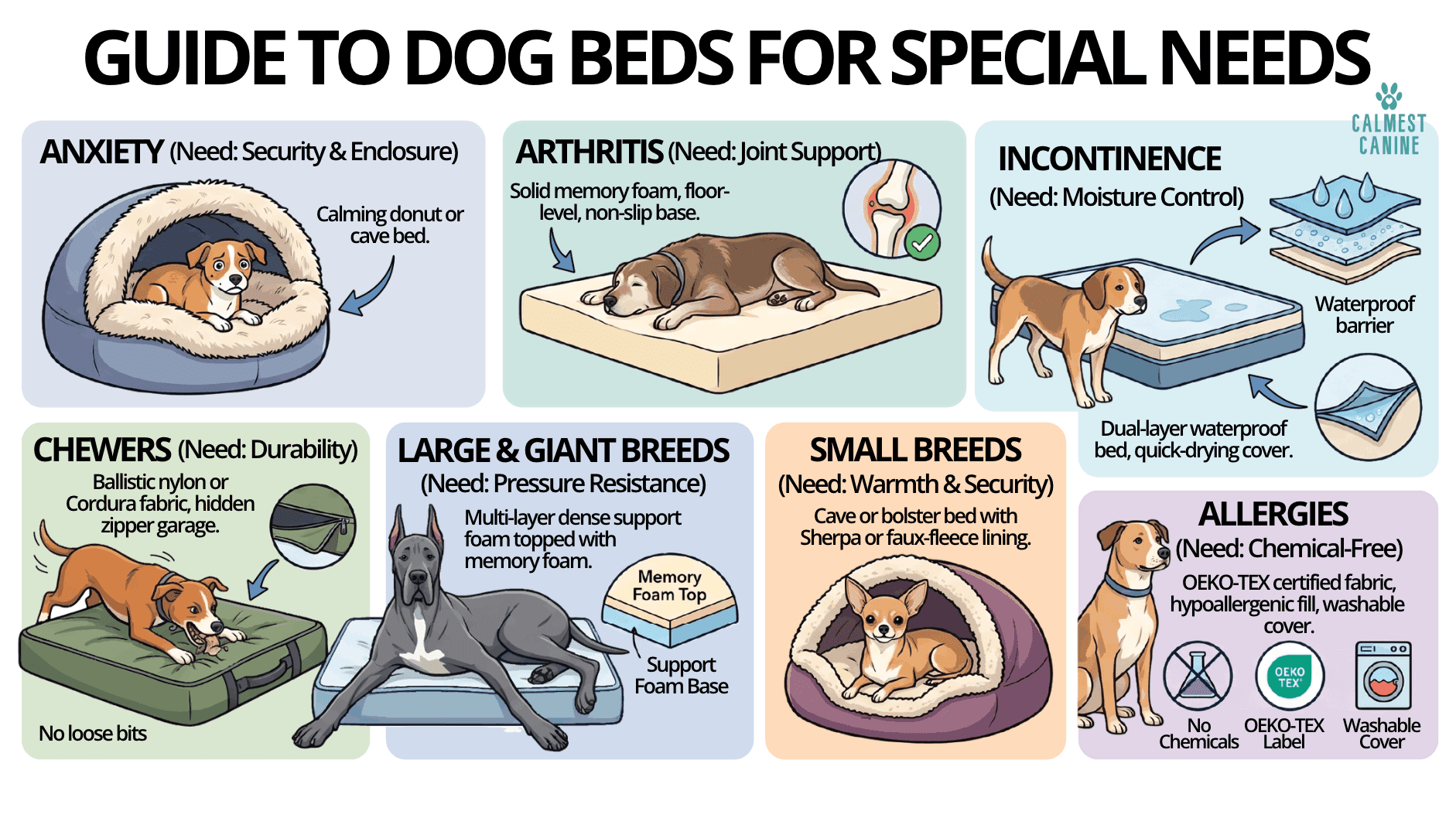
- The Solution: Opt for calming donut beds made with long-fiber faux fur that mimics the warmth of a littermate, along with high cushioned edges that provide a gentle pressure sensation around their body.
- The Strategy: Move the bed to a low-traffic corner or a semi-enclosed space, such as under a desk, to minimize visual triggers that can spike stress levels. Bed choice and placement must work together. Getting one right without the other limits how much either can help.
Dogs With Arthritis: Prioritizing Joint Health
For dogs with arthritis, lying down or standing up can be painful. The bed should make both easier, not harder.
- The Solution: A solid high-density memory foam is better than shredded foam. A solid slab won’t shift or compress unevenly under the dog’s weight, avoiding the painful bottoming out that undermines the purpose of an orthopedic bed.
- The Strategy: Avoid placing arthritic dogs on slick floors where they might slip when standing up. Ensure the bed has a rubberized, non-slip bottom to keep it completely stationary during transitions because a shifting mattress makes an already painful movement significantly harder.
⚠️ Arthritis Warning: Elevated Beds
While elevated cot-style beds are excellent for cooling, their rigid frames make climbing on and off genuinely difficult for arthritic dogs. Opt for a thick, floor-level mattress with a non-slip bottom to prevent slipping during transitions from lying down to standing up.
Incontinent Dogs: Hygiene Without the Hassle
Whether it’s a puppy still mastering house-training or a senior dog managing bladder leaks, moisture control is non-negotiable for preventing skin infections and maintaining a livable environment.
- The Solution: Look for a bed with dual-layer waterproofing, including a waterproof outer cover and a secondary waterproof inner liner to protect the foam core from moisture.
- The Strategy: Choose an outer cover made from quick-drying synthetic fabric, allowing you to wash and replace it within hours rather than leaving your dog without a bed for an entire day.
Destructive Chewers: Protecting Your Investment
If you’ve gone through three beds in three months, changing brands won’t help — find out how to stop your dog from chewing their bed, starting with switching to more durable materials and addressing the behavioral triggers behind it.
- The Solution: Look for beds made from ballistic nylon or Cordura fabric. These puncture-resistant materials lack the loose edges that tempt dogs to chew.
- The Strategy: Avoid giving a chewer a bed with exposed zippers or tassels. Instead, look for beds with hidden zipper pulls tucked under a fabric flap—sometimes called a “zipper garage”—to eliminate one of the most common starting points for destruction.
Large & Giant Breeds: Preventing the “Bottom Out”
A 100-pound Great Dane puts enormous pressure on a bed. Most XL beds available in standard retail stores are simply larger versions of poorly constructed beds and can flatten within weeks under sustained heavy weight.
- The Solution: Choose a bed with multi-layer construction that features a base of dense support foam topped with a layer of pressure-relieving memory foam. This combination ensures the bed resists flattening under heavy weight while still providing contouring comfort for your dog’s joints.
- The Strategy: Ensure the bed is long enough to allow full limb extension. If their legs or elbows hang off the edge, their spine won’t receive proper support.
Small Breeds: Warmth and Security
Small dogs tend to lose body heat significantly faster than large breeds and often feel exposed and vulnerable in spacious rooms.
- The Solution: Consider cave beds or bolster beds that trap body heat and offer enclosed walls for a sense of security.
- The Strategy: Small breeds often prefer ultra-soft plush textures like Sherpa, Minky or faux-fleece, which provide warmth and a sense of being held, especially during cooler months or in air-conditioned environments.
Dogs With Allergies or Skin Sensitivities: The Hypoallergenic Priority
For dogs dealing with environmental or contact allergies, the bed itself can either trigger their allergies or play a vital role in their management plan.
- The Solution: Look for beds made with OEKO-TEX certified fabrics, ensuring they are free of dyes, formaldehyde, and chemical finishes. Hypoallergenic fill materials, such as recycled polyester fiber, are preferable to down or wool, which can harbor dust mites.
- The Strategy: Select a removable, machine-washable cover that handles frequent weekly washing in hot water without shrinking, pilling, or fraying. For dogs managing ongoing allergies, a cover that can be washed frequently without degrading is just as important as the materials beneath it.
Regardless of your dog’s specific condition, the right bed comes down to three factors: material, structure, and washability.
If you’re managing more than one condition or want a quick reference before making a purchase decision, the table below summarizes the key recommendations for each special need covered in this section.
| Condition | Primary Need | Recommended Bed Type |
|---|---|---|
| Anxiety | Security and enclosure | Calming donut or cave bed |
| Arthritis | Joint support | Solid memory foam, floor-level |
| Incontinence | Moisture management | Dual-layer waterproof bed |
| Chewing | Durability | Ballistic nylon or Cordura |
| Large breeds | Pressure resistance | Multi-layer support foam |
| Small breeds | Warmth and security | Cave or bolster with plush texture |
| Allergies | Chemical-free materials | OEKO-TEX certified, hypoallergenic fill |
Conclusion: Investing in Your Dog’s Rest
The right bed in the right place makes a measurable difference in more than just the quality of your dog’s sleep. It shows up in their morning mobility, their confidence during thunderstorms, and their overall behavior at home.
A bed your dog never uses isn’t a purchase — it’s a decoration. The right fit always starts with their needs, not your living room.
You’re not just purchasing furniture. You’re investing in how comfortably your dog moves through their world and how securely they occupy their place in your home.