This post may contain affiliate links. If you click one of them, we may receive a commission at no cost to you. We only recommend products or services we believe will add value to our readers. For more information, click here.
You just realized your dog has been napping on the cold hardwood floor, again, because their one bed is in the wrong room. Sound familiar?
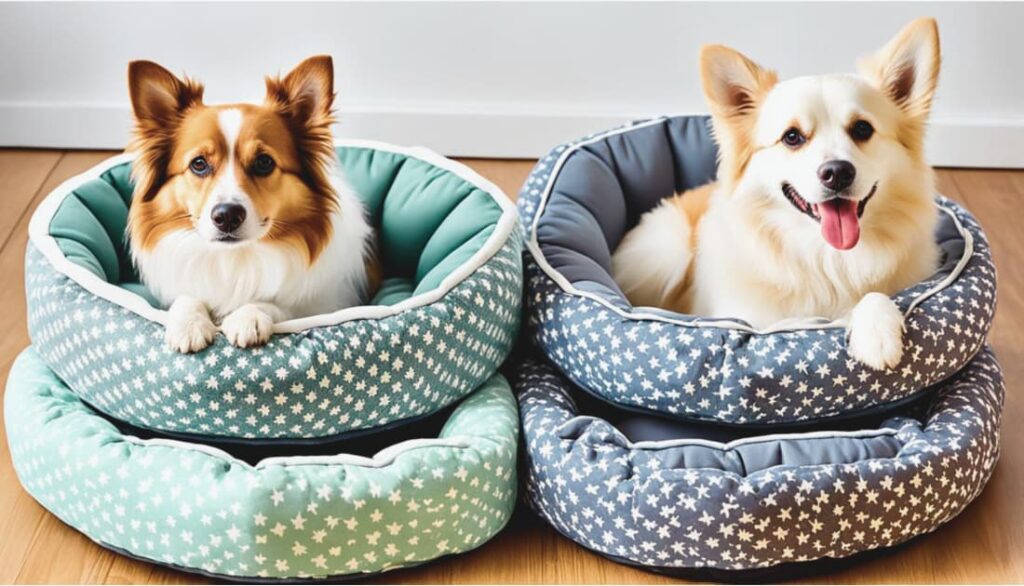
Plenty of articles discuss which type of bed to buy, but very few answer the real question: how many dog beds should a dog actually have?
The truth is, there’s no single answer, and that’s actually good news. It means the right number is personal to your dog. The AKC recommends providing more than one bed in most cases, but the magic number depends on your dog’s age, health, and daily habits.
For a senior dog with arthritis, multiple orthopedic beds are a genuine necessity for their health. For a Velcro dog who follows you from room to room, a dedicated spot in every area is a game-changer for their comfort and your back.
In this guide, we’ll help you figure out exactly how many beds your dog needs and where to put them.
As a dog owner, you know your furry friend has an uncanny talent for finding the most comfortable spot in the house, whether it’s a plush armchair, your own pillows, or an unconventional corner under the dining table.
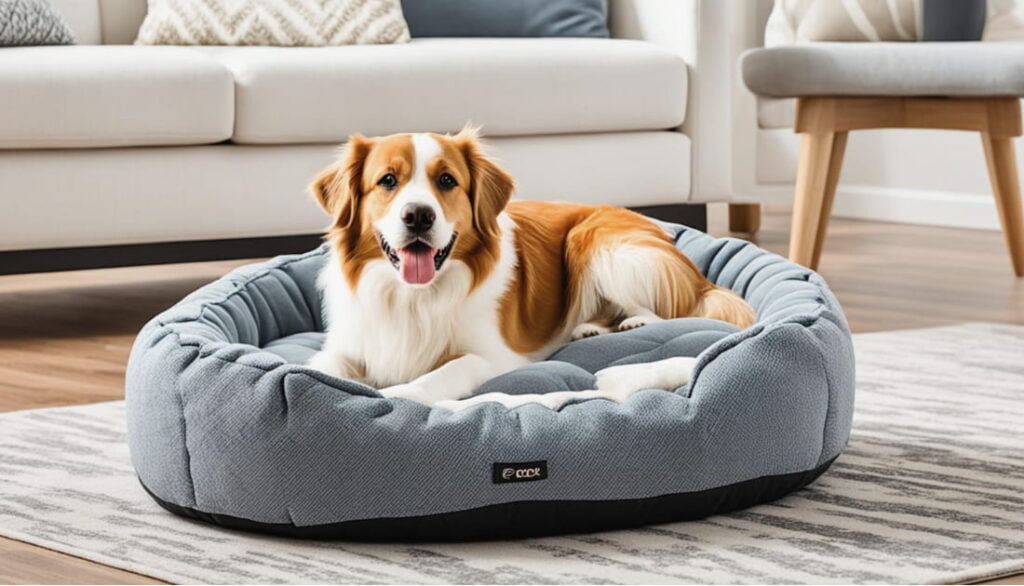
However, these makeshift spots don’t provide the structural support your dog needs. Establishing a designated ‘home base’ is essential for their health, offering more than just a soft place to land.
Here is what a quality dog bed actually does for your pet:
Mental Security: A bed serves as a psychological haven for your dog—a recognized space that belongs to them when they need to unwind from a bustling household.
Joint & Bone Support: Quality beds provide a buffer between your dog and the hard floor. This is a health priority for senior dogs or breeds prone to arthritis, as it improves morning mobility and relieves daily discomfort.
Allergen Protection: A raised or cushioned surface protects your pet from the dirt, dust mites, and allergens that naturally settle on floorboards and carpets.
Home Cleanliness: By giving your dog a preferred place to lounge, you can concentrate shedding and dander in one washable area rather than across your entire sofa.
If you have been questioning whether a bed is a luxury or a necessity, recognize it as a fundamental tool for improving your pet’s long-term quality of life.
Is One Dog Bed Enough? Factors to Consider
Now that we have established why every dog needs a bed, the question remains: how many dog beds should your dog have?
As simple as this question may seem, it’s kind of like asking someone, “How many pairs of shoes should a person own?” There isn’t really a one-size-fits-all answer.
Some owners feel one indoor bed is enough, adding an outdoor bed later. Others place a bed in every room so their dog always has a nearby spot.
So, who’s right? The truth is, there is no ‘perfect’ number; only the right number for your home. To find that number, we have to look at four key factors: sleeping preferences, age, health, and your home’s layout.
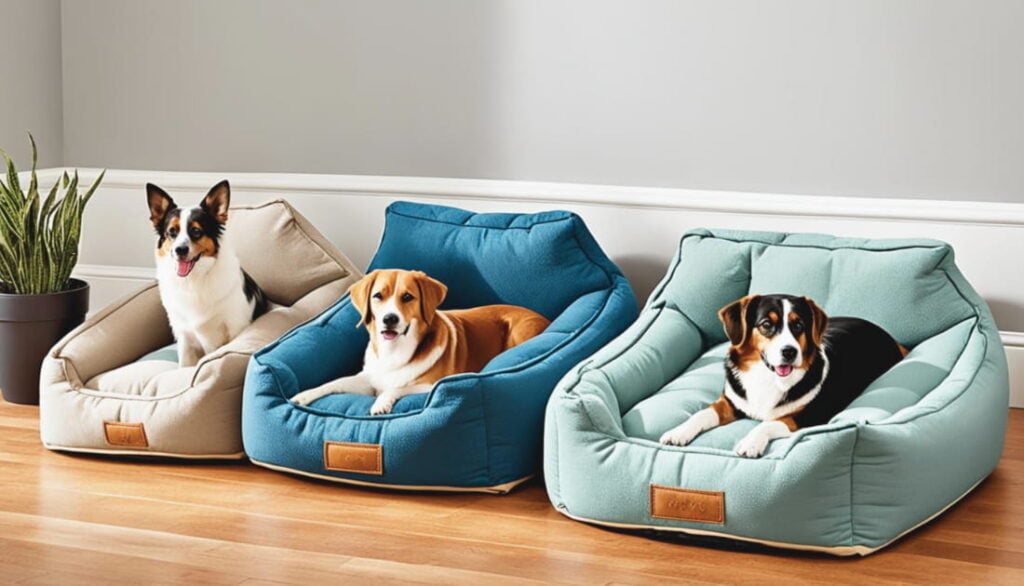
For example, dogs like to change their sleeping positions throughout the day. They might burrow or curl up for a deeper nighttime sleep, but prefer to stretch out when taking naps during the day. A donut or bolster bed works beautifully for nighttime nesting, while a flat orthopedic or elevated bed suits post-play sprawling.
If you are not sure which type of bed fits your dog’s sleeping style, our complete guide to dog beds breaks down how each type functions and who it works best for.
Sleep Style
Best Bed Type
Why it Works
The Curler
Donut/Bolster Bed
Provides a sense of security and warmth
The Sprawler
Flat Mattress/Large Mat
Allows for full limb extension and cooling
The Burrower
Cave/Hooded Bed
Satisfies the instinct to hide and nest
The Leaner
Bolster/Couch-Style Bed
The raised edge supports the head and neck
Overall, having two separate beds creates a designated space for each need: one for nighttime sleep and one for post-play relaxation.
By catering to your dog’s natural sleep preferences, you can help them feel comfortable and secure throughout the day, resulting in a happier and well-rested pup.
Age and the Number of Dog Beds
A dog’s age is one of the biggest drivers of their ‘magic number.’ As our loyal companions progress through different life stages, their bodies and energy levels change, and so should their bed count.
Puppyhood: The ‘Pit Stop’ Phase
Energetic puppies thrive on short, frequent naps between ‘zoomies.’ Having 2 to 3 beds scattered around the house ensures your pup has a nearby spot to crash before their next play session.
Plus, we have to talk about the reality of teething. Puppies are heavy chewers, and having a backup bed in the closet means you aren’t left with a floor full of stuffing and a dog with nowhere to sleep on a Sunday night.
The Adult Years: Establishing a Routine
Adult dogs typically require fewer beds, but having two remains a good standard — one for their main sleeping area and another for where they spend most of their daytime hours.
The Senior Years: Support and Accessibility
As dogs age, they often face challenges such as arthritis or general muscle weakness, which may require extra support. This is where having multiple beds shifts from being a convenience toa health necessity.
Orthopedic Support: Placing supportive beds in various rooms helps senior dogs avoid long walks across hard floors in search of relief.
Temperature Regulation: Older dogs struggle more with temperature. Multiple beds allow them to choose a warm, sunny spot in the morning and a cool, shaded corner in the afternoon without overexerting themselves.
By providing a variety of resting spots, you’re helping your dog thrive at every stage, and helping your senior dog manage their limited mobility with dignity and comfort.
Life Stage
Recommended Beds
Best Bed Type
Puppy (0–2 yrs)
2–3
Durable/chew-resistant beds
Adult (2–7 yrs)
2+
Comfort or activity-specific beds
Senior (7+ yrs)
3+
Orthopedic or memory foam beds
Do You Live in a Multi-Dog Household?
In a multi-dog home, the math changes. Most behaviorists recommend a simple rule: one bed per dog, plus one extra.
The “plus one” matters more than it might seem. There’s always a prime spot, likely the sunny patch by the window or the corner closest to you, and without a backup option, that spot becomes a source of competition.
An extra bed ensures there’s always somewhere else to go, preventing the kind of low-level resource guarding that can quietly undermine an otherwise peaceful household.
Beyond avoiding conflict, there are two other reasons individual beds matter:
Individualized support: Every dog has different needs. Your senior dog might need high-density memory foam, while your puppy needs something chew-resistant and easy to clean. Assigning specific beds ensures each dog gets what their body actually requires.
Uninterrupted sleep: Dogs need deep, restful sleep for immune function and cognitive health. Having their own designated space allows them to fully relax without a housemate disturbing them in the middle of their sleep cycle.
Providing a separate bed for each dog is not just a purchasing decision; it’s one of the easiest methods to alleviate tension and enhance well-being for the entire household.
11 Reasons You Should Have Multiple Dog Beds
I used to think that finding the perfect dog bed was like finding a needle in a haystack until I realized I was looking for the wrong thing entirely. Spoiler: There is no perfect bed. There’s just the right collection of beds.
Whether you’re catering to a senior dog’s joints or a puppy’s zoomies, here are 11 compelling reasons why multiple dog beds are a genuine necessity for your home.
1. Velcro Dogs: When Your Dog Follows You Around the House
If your dog has ever followed you to the bathroom and sat outside the door, you already know exactly what this means.
Picture this: you’re on the couch reading a book, your dog asleep at your feet. Sounds nice, right?
Now imagine moving to the bedroom. With one bed, you’re either carrying it with you or leaving your dog without a comfortable spot to settle, and for a Velcro dog, that second option isn’t really an option at all.
A bed in each room solves this instantly. Your dog always has a designated resting place wherever you are, and you never have to think about it.
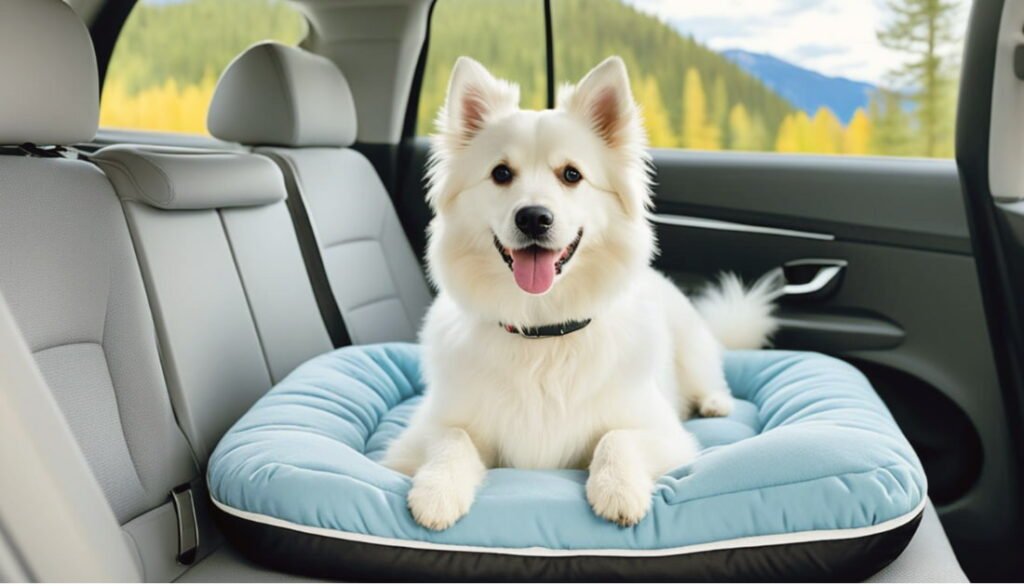
2. Traveling With Your Pet: Use a Portable Bed for On-The-Go
Sometimes the right number of dog beds extends beyond your home.
If you travel regularly with your dog, whether on road trips, hotel stays, or family visits, lugging a full-sized indoor bed isn’t practical. A dedicated travel bed solves this: lightweight, packable, and easy to set up wherever you land.
But convenience is only half of it. Traveling puts dogs in unfamiliar environments, which can quietly trigger anxiety. Having a bed they recognize gives them a consistent sensory anchor; it is something that smells and feels like home when everything else doesn’t.
Especially for dogs that struggle with new environments, that familiarity can make the difference between a settled dog and a stressed one. A travel bed isn’t an indulgence; it’s one of the simplest ways to make trips easier for both of you.
3. Supporting Dogs with Health Conditions
For dogs managing health conditions, comfort during rest isn’t a luxury; it’s part of their care.
These conditions don’t switch off when your dog lies down. Discomfort persists through rest, which means where and how your dog sleeps directly affects their quality of life. Orthopedic and memory foam beds help by distributing weight evenly and relieving pressure on sore joints.
As you can see in the diagram below, pain points in the hips, shoulders, and spine are common in some breeds; orthopedic foam beds act as a buffer for these specific areas, allowing for more restorative rest.
Figure 2: Understanding where dogs most commonly experience arthritis and joint pain explains why having multiple orthopedic or supportive beds throughout your home is crucial, especially for senior pets.
The same logic applies to dogs managing incontinence due to age or illness. Having multiple beds placed around the home means there’s always a clean, dry option nearby, reducing stress for your dog and making management easier for you.
4. Anxious Dogs: Why They Need More Than One Bed
The benefits of a dog bed extend well beyond physical support. For anxious dogs, a well-placed bed can serve as a genuine psychological retreat. If your dog has ever wedged themselves behind the sofa during a fireworks display, you already understand this instinct.
Dogs experience stress from house guests, thunderstorms, fireworks, or simply an unpredictable day. In these moments, a familiar bed in a quiet corner gives them a place to decompress on their own terms. It becomes a space that’s consistently theirs, regardless of what’s happening around them.
Calming beds, typically designed with raised bolster edges and ultra-soft materials that mimic the feeling of being held, can be particularly effective for dogs with higher anxiety levels.
Keeping one in a low-traffic area of your home gives your dog a reliable retreat they can find and use independently.
📌 Pro Tip: To make a new calming bed even more effective, try placing an unwashed t-shirt of yours inside it for the first few days. The combination of the bolster support and your familiar scent can lower a dog’s cortisol levels even faster.
5. Maintain Cleanliness with Multiple Dog Beds
Dog beds take a beating from muddy paws, shedding fur, drool, and general wear, so regular washing isn’t optional; it’s essential. This is especially true for dogs prone to allergies or skin sensitivities, where a regularly washed bed can make a noticeable difference in their comfort and health.
The practical advantage of multiple beds is simple: while one is in the wash, your dog always has a clean, dry place to rest. No rushing through laundry cycles, and no leaving your dog without a comfortable spot while you wait for a bed to dry.
Beyond general daily use, dogs engage in pre-sleep rituals, such as circling, pawing, and scratching. These actions are actually instinctive denning behaviors inherited from wild ancestors, who would flatten grass or leaves before lying down.
Repeated night after night on a single bed, that ritual adds up. Add puppyhood chewing into the equation, and one bed can deteriorate surprisingly quickly.
Spreading the wear across multiple beds significantly extends each one’s life, which, over time, is much cheaper than replacing a single bed every few months.
7. You Have a “No Pets on the Furniture” Policy
When we first brought our puppy home, we had a strict “no dogs on the furniture” rule, at least until he was fully potty-trained.
Keeping that boundary isn’t always easy, especially when those puppy dog eyes are pleading for a spot on the couch. But there are practical reasons worth holding firm. Dogs track dirt, mud, and outdoor allergens inside with every walk.
Furniture accumulates dust quickly, and for those with allergies or sensitivities, pet dander trapped in upholstery can be a significant issue. Professional furniture cleaning can be quite expensive; the cost of a single session often exceeds that of a high-quality dog bed.
Giving your dog several comfortable, strategically placed beds makes the alternative genuinely appealing. A dog that has a warm, familiar bed nearby is far less likely to make a case for the sofa.
8. Enhance Crate Training Success with Multiple Beds
Despite its reputation, acrate isn’t a punishment; it’s a den. Dogs are naturally drawn to enclosed spaces that feel safe and secure, and a well-set-up crate directly appeals to that instinct.
The key to making it work is association. A crate that contains a comfortable, snug-fitting bed, a familiar toy, and occasional treats becomes a place your dog actively chooses rather than tolerates. The bed is doing more work than it might seem; it’s the sensory anchor that makes the space feel like theirs.
For a puppy in training, a flat, durable mat often works better than a plush bolster bed. Mats are easier to clean and harder to chew during the teething phase.
This is where multiple beds play a role. Having a dedicated crate bed that stays in the crate, separate from their main sleeping bed, helps your dog build a clear association between that space and rest.
It also means you’re not constantly moving beds around, which disrupts the consistency that makes crate training work in the first place. Over time, the crate becomes less of a training tool and more of a retreat your dog returns to on their own terms.
9. Accommodate Weather Changes with Multiple Kinds of Dog Beds
Temperature affects your dog’s comfort and sleep quality more than most owners realize, and a single bed rarely suits both ends of the seasonal spectrum.
In winter, plush bolster beds and self-warming options with thermal linings help dogs retain body heat while resting. In summer, the same bed can become uncomfortably warm; elevated or cooling beds allow airflow underneath, helping to regulate body temperature naturally.
Having both options available means your dog always has somewhere genuinely comfortable to rest, regardless of the season, rather than having to tolerate a bed that wasn’t designed for the current conditions.
Season
Recommended Bed Type
Why it Works
Winter
Plush bolster or self-warming bed
Retains body heat and provides insulation
Summer
Elevated or cooling bed
Promotes airflow and prevents overheating
Year-round
Orthopedic or memory foam
Consistent joint support regardless of temperature
10. Active Dogs Need More than One Dog Bed
Dog beds aren’t just for nighttime, which is why your dog’s activity level and lifestyle should directly influence the types of beds you choose.
For dogs that join you on hikes, camping trips, or spend significant time outdoors, a dedicated outdoor bed is worth the investment. These beds are made from water-resistant, weather-durable materials designed to withstand mud, moisture, and rough terrain — things a standard indoor bed won’t survive.
For high-energy dogs who spend their days running, chasing, and playing, recovery matters as much as the activity itself. A memory foam or orthopedic bed molds to your dog’s body after intense physical activity, supporting muscle recovery and reducing joint pressure, much like an athlete uses a recovery tool post-training.
Matching the bed to the activity isn’t an indulgence; it’s the logical extension of everything else you do to keep an active dog healthy.
11. Letting Your Canine Choose from a Variety of Quality Beds
The simplest reason of all: choice matters.
Dogs in the wild don’t have a single designated sleeping spot. They instinctively rotate where they rest based on the time of day, the temperature, and even how secure they feel in that moment.
Providing a variety of options, a bolster bed for nesting, a cooling mat for post-walk relief, and a quiet crate bed for decompression, empowers your dog to listen to their own instincts. When a dog has the autonomy to choose their own comfort, they tend to be more settled, less anxious, and more at peace in their environment.
Variety isn’t about spoiling them. It’s about acknowledging that your dog has preferences, instincts, and needs that a single bed will not meet.
So, How Many Dog Beds Should a Dog Have?
After exploring the factors to consider and the benefits of multiple beds, it’s time to answer the question directly.
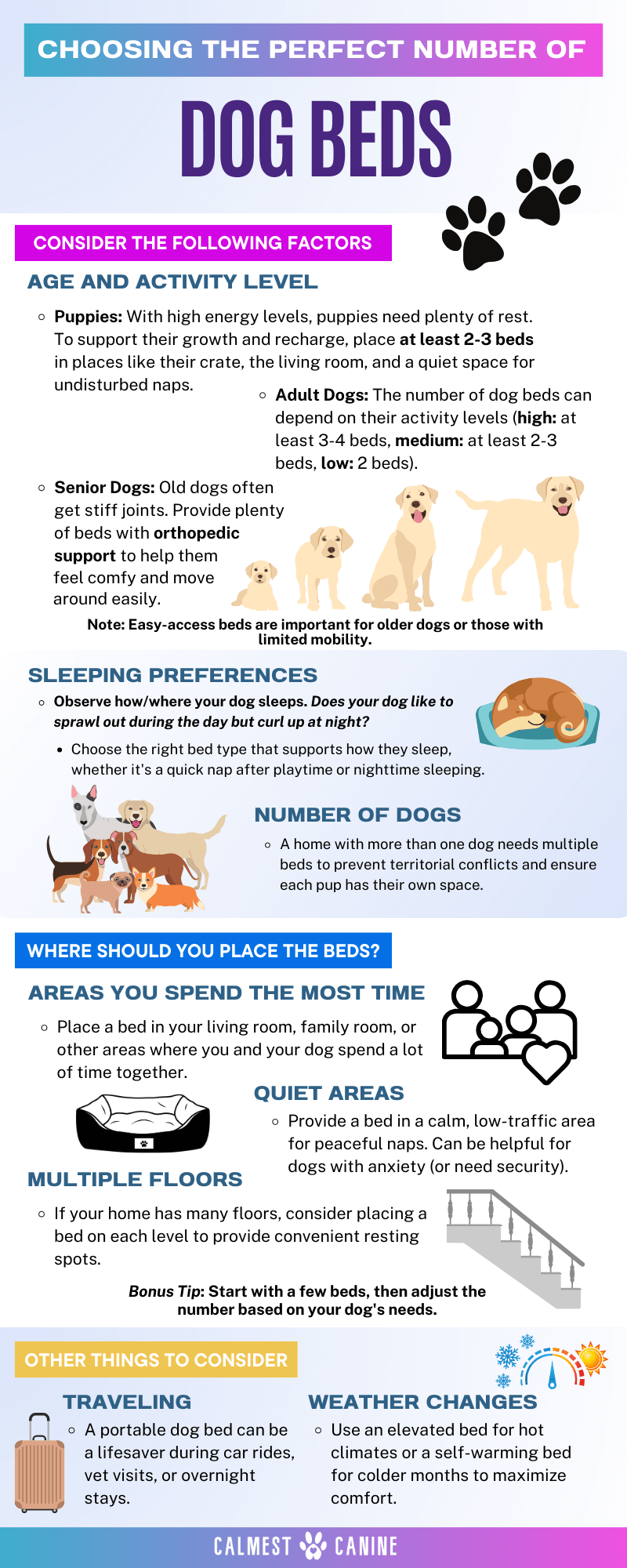
The honest answer is that there’s no universal number, but there is a right number for your dog. The infographic below highlights the key factors: age, activity level, sleeping preferences, and home layout.
Using this guide as a framework, here are some real-life scenarios that show how the right number of beds looks different for every dog.
Scenario 1: Managing Arthritis and Joint Pain
Cooper, an 8-year-old Labrador Retriever, was beginning to show signs of hip arthritis. His walks were getting shorter, and jumping on and off the couch had become a visible struggle.
For Cooper, health and mobility were the primary drivers behind every bed placement decision.
Age: At 8, Cooper was still relatively active, but his joint pain made any unnecessary movement uncomfortable.
Health: Hip arthritis meant that hard floors, long distances between rooms, and unsupported surfaces contributed to his daily discomfort.
Household: One dog.
David’s Solution — 4 beds:
Bedroom: An elevated orthopedic bed next to David’s side of the bed for easy nighttime access without jumping.
Living room: A large orthopedic bed near the window — perfect for sun naps and keeping watch over the neighborhood.
Dining area: A comfortable bed where Cooper could rest nearby during mealtimes without lying on the hard floor.
Outdoors: A weather-resistant bed on the patio so Cooper could stretch out in the sun without lying on hard concrete.
David also added a dog ramp to help Cooper get on and off the couch independently.
The Result:
Cooper no longer has to travel across the house to find somewhere comfortable to rest. The reduction in unnecessary movement made a measurable difference. Now, he’s more settled between walks and visibly less stiff in the mornings.
Scenario 2: The Velcro Dog
Rex is a 2-year-old Beagle with boundless energy and one non-negotiable requirement: Mary, his owner, must always be within sight.
For Rex, lifestyle and attachment were the primary drivers. Unlike Cooper, this wasn’t about managing a health condition; it was about working with his personality.
Lifestyle: Mary works from home and moves between rooms frequently throughout the day. Rex follows her to every single one.
Sleeping preferences: He sprawls out during the day but curls up tightly at night and always within view of Mary.
Household: One dog.
Mary’s solution — 3 beds + 1 travel bed:
Bedroom: A round bolster bed next to Mary’s bed that is close enough for Rex to feel settled without sharing her space.
Home office/Living room: A plush bed near the window (or desk), giving Rex a designated spot to relax while keeping Mary in his sightline.
Dining Area: A flat mat placed just outside the kitchen entryway, allowing Rex to settle and watch Mary cook without being underfoot or near hot splashes.
Travel bed: A lightweight, packable bed that accompanies Rex and Mary on road trips and overnight stays, giving Rex a familiar sensory anchor in unfamiliar environments without the bulk of an indoor bed.
The Result:
Rex still gravitates toward wherever Mary is — that’s just who he is. But instead of pacing or hovering, he now has a comfortable, familiar spot waiting for him in every room. The travel bed means that consistency follows them on the road, too.
Scenario 3: Puppies and Crate Training
Luna is an 8-week-old Chihuahua and the newest addition to Noelle’s home. She’s curious and eager to explore, but gets visibly anxious around strangers and unfamiliar environments.
For Luna, temperament and the demands of early puppyhood were the primary drivers. At 8 weeks, the goal wasn’t comfort optimization; it was building a foundation of security in an entirely new environment.
Age and development: At 8 weeks, Luna has high sleep needs, a short attention span, and is in the critical early stages of both crate and potty training, all of which directly influence bed placement and bed type.
Temperament: Luna gravitates toward enclosed, contained spaces — an instinct for a dog that feels safest when sheltered. Her anxiety around strangers made a dedicated retreat space especially important.
Household: Two dogs. Luna’s housemate has his own beds already, so this plan covers Luna’s needs specifically.
Noelle’s solution — 2 beds:
The crate: A small, snug-fitting flat mat inside Luna’s crate that was chosen for its durability and ease of cleaning during the early potty-training phase.
A quiet area: A soft bed in a low-traffic corner of the home where Luna can decompress after playtime or retreat when the household feels overwhelming.
The Result:
Within a few weeks, Luna began choosing to enter her crate on her own. This was a reliable sign that the space had become genuinely comfortable rather than something to avoid.
The quiet area bed gave her a familiar anchor point outside the crate, helping ease her anxiety around new people by providing a safe place to retreat on her own terms.
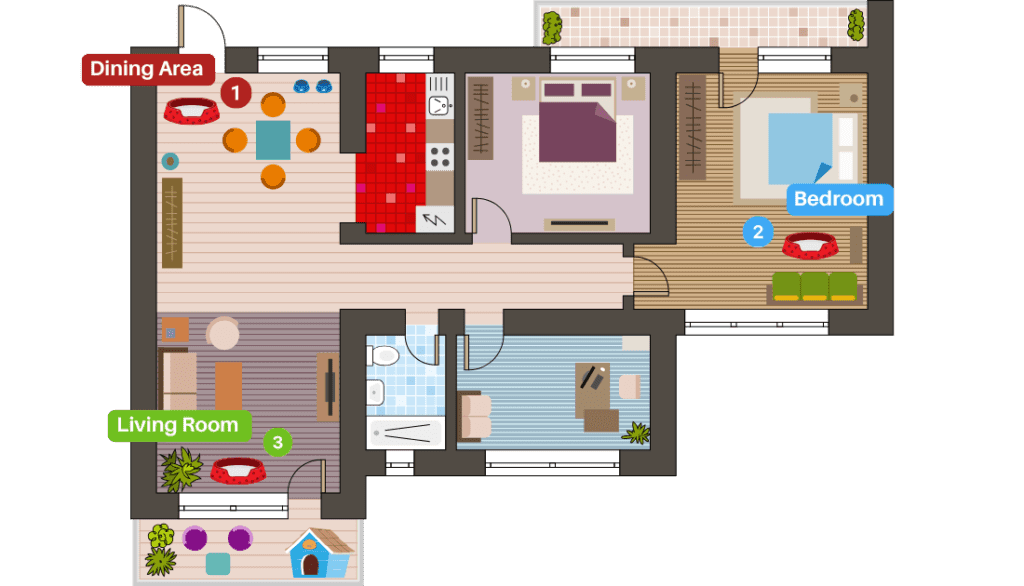
💡 Tip: Before making your final decisions, consider sketching a rough floor plan of your home and marking where each bed will go.
Seeing the layout visually often reveals gaps you wouldn’t notice otherwise. Maybe there is a room your dog spends time in that doesn’t have a bed, or two beds placed too close together to serve different purposes.
An example floor plan illustrating how dog beds can be distributed across a home, each numbered marker represents a different placement zone.
More than one bed isn’t overindulging your dog; it’s simply one way you can meet their needs across different parts of their day.
How to Get Your Dog to Use Their Bed
You present your dog with a brand new bed, and they promptly ignore it in favor of the cold kitchen floor. If this sounds familiar, you’re not alone, and it’s easier to fix than it seems.
Here are five steps to help your dog start using their designated sleeping spot:
Start with familiar surroundings: Place the bed in an area where your dog already likes to rest. Familiarity reduces hesitation and makes the new bed feel like a natural extension of their space.
The treasure hunt: Scatter a few favorite toys or treats on the bed to pique their curiosity and encourage them to investigate on their own terms.
Positive luring: Gently guide your dog toward the bed using an encouraging tone. If they’re hesitant, use a high-value treat to lure them onto it. Then, each time they make contact, reward them.
Praise and reward: Every time your dog chooses the bed over the furniture, mark it with praise and a treat. You’re building an association, not enforcing a rule.
Consistency: Regularly encourage your dog to use the bed and gradually increase the time they spend on it. Keep every session positive. Frustration undoes the progress quickly.
A couple of additional tips worth mentioning:
Use familiar scents: Place a worn piece of clothing or a familiar blanket on the bed. Your scent is one of the most powerful reassurances you can offer a dog in an unfamiliar situation.
Establish a bedtime routine: A consistent cue, whether a calm phrase, gentle petting, or a specific treat, signals that it’s time to settle. Over time, your dog will begin to anticipate the routine and move to their new bed independently.
The common thread across all of these steps is patience. A dog that takes two weeks to embrace a new bed fully isn’t being stubborn; they’re just adjusting at their own pace.
Key Takeaways
There’s no single right answer to how many beds your dog needs, but after everything we’ve covered, the framework is clear. Start with at least two: one for their primary sleeping area and one for where they spend most of their day.
From there, your dog’s age, health, activity level, and personality will tell you the rest. A senior dog with arthritis needs more than a healthy two-year-old. A Velcro dog needs a familiar spot in every room. An anxious dog needs a quiet retreat that’s consistently theirs.
The through line across all of it is this: a dog bed isn’t a decorative purchase or an act of spoiling. It’s one of the most practical investments you can make in your dog’s daily comfort and long-term health.
FAQs
Should 2 dogs have their own beds?
Yes — each dog should have their own bed plus one extra. Individual beds prevent territorial disputes over prime sleeping spots and ensure each dog gets the specific support their body needs. A shared bed might seem practical, but it’s one of the most common sources of low-level tension in multi-dog households.
Do puppies need to have 2 beds?
Yes — puppies nap frequently throughout the day and benefit from having a familiar resting spot in each area they spend time in. A dedicated crate bed and a separate quiet-area bed are the minimum for most puppies. During teething, opt for flat, durable mats over plush beds — they’re easier to clean and harder to destroy.
Does my dog need a crate and a bed?
Yes — and ideally both. A crate provides structure and a den-like sense of security, while a bed makes that space genuinely comfortable. A crate without a bed is just an empty box; together, they create a space your dog actively chooses rather than just tolerates. This positive association is the foundation of successful crate training.
Should my dog’s bed be placed inside the crate?
Yes. A snug-fitting bed transforms a crate from a containment tool into a genuine retreat. For puppies still in potty training, choose a flat, washable mat rather than a plush bed — accidents are inevitable and, easy cleanup matters.
Where should my new dog sleep the first night at home?
A quiet, enclosed space close to you — ideally a crate in your bedroom. The first night is overwhelming for most dogs, and your proximity provides vital reassurance. Limiting their access to a small, comfortable area prevents them from feeling lost in a new house and sets a calm foundation for the nights to follow.
Do dogs like soft or hard beds more?
It depends on the dog. Puppies and healthy adult dogs often prefer softer, plush surfaces. Senior dogs or breeds prone to joint issues typically do better on firmer orthopedic or memory foam beds that provide structured support rather than just cushioning. Watch where your dog naturally chooses to rest — the floor or the sofa — for clues about their preference.
How do I know if my dog’s bed is the right size?
Your dog should be able to stretch out fully without limbs hanging off the edge. To find the right fit, measure your dog from nose to tail and add 6–10 inches. While dogs often curl up, they change positions throughout the night; a bed that is slightly too large is always better than one that’s too small.
Can a dog have too many beds?
Not really — as long as each bed serves a purpose. A bed in every room your dog spends time in is practical, not excessive. The only consideration is ensuring each bed is regularly washed and maintained. An unused bed that collects dust and dander isn’t benefiting anyone — placement and purpose matter more than the number itself.
How often should I replace my dog’s bed?
Most quality dog beds last 1 to 3 years, depending on the material and how heavily they’re used. Signs it’s time to replace include visible flattening of the fill, a persistent odor that washing doesn’t resolve, damaged seams, or your dog avoiding the bed altogether. A bed that no longer provides support isn’t just uncomfortable — it’s no longer doing its job.
Sources
1. AKC Staff. (2026, March 4). Choosing the right dog bed for your dog. American Kennel Club. https://www.akc.org/expert-advice/home-living/choosing-right-dog-bed/
2. Becher, R., Øvrevik, J., Schwarze, P. E., Nilsen, S., Hongslo, J. K., & Bakke, J. V. (2018). Do Carpets Impair Indoor Air Quality and Cause Adverse Health Outcomes: A Review. International journal of environmental research and public health, 15(2), 184. https://doi.org/10.3390/ijerph15020184
3. Bódizs, R., Kis, A., Gácsi, M., & Topál, J. (2020). Sleep in the dog: Comparative, behavioral and translational relevance. Current Opinion in Behavioral Sciences, 33, 25–33. https://doi.org/10.1016/j.cobeha.2019.12.006
4. Eisele P. H. (2001). A practical dog bed for environmental enrichment for geriatric beagles, with applications for puppies and other small dogs. Contemporary topics in laboratory animal science, 40(3), 36–38.
5. Emory Health Sciences. (2014, March 18). Scent of the familiar: You may linger like perfume in your dog’s brain. ScienceDaily. Retrieved April 23, 2024 from www.sciencedaily.com/releases/2014/03/140318112026.htm
6. Grenus, B., DVM. (2023, September 21). How to crate train a puppy. PetMD. https://www.petmd.com/dog/general-health/crate-training-puppies
7. Intervertebral disc disease. (2024, January 19). Cornell University College of Veterinary Medicine. https://www.vet.cornell.edu/departments/riney-canine-health-center/canine-health-information/intervertebral-disc-disease
8. Kleszynski, B. (2025, December 19). How to keep your senior dog healthy this winter. PetMD. https://www.petmd.com/dog/general-health/how-to-keep-senior-dog-healthy-this-winter
9. Luxating Patella. (2018, May 22). Cornell University College of Veterinary Medicine. https://www.vet.cornell.edu/departments-centers-and-institutes/cornell-feline-health-center/health-information/feline-health-topics/luxating-patella
10. Madson, C. (2020, July 28). Resource guarding in dogs: What to do (and NOT do) (C. Madson, Ed.). Preventive Vet. https://www.preventivevet.com/dogs/resource-guarding-in-dogs
11. Paretts, S. (2021, September 2). The importance of a good dog bed. American Kennel Club. https://www.akc.org/expert-advice/health/the-importance-of-a-good-dog-bed/
12. Salonen, M., Sulkama, S., Mikkola, S., Puurunen, J., Hakanen, E., Tiira, K., Araujo, C., & Lohi, H. (2020). Prevalence, comorbidity, and breed differences in canine anxiety in 13,700 Finnish pet dogs. Scientific reports, 10(1), 2962. https://doi.org/10.1038/s41598-020-59837-z
13. Schachner, E. R., & Lopez, M. J. (2015). Diagnosis, prevention, and management of canine hip dysplasia: a review. Veterinary medicine (Auckland, N.Z.), 6, 181–192. https://doi.org/10.2147/VMRR.S53266
14. Solutions, A. P. (2023, September 25). Do dogs need separate beds? AllPetSolutions. https://www.allpetsolutions.co.uk/blogs/pet-advice/separate-beds
15. Williams, K., Llera, R., & Buzhardt, L. (2024). Why dogs turn around before lying down. VCA Animal Hospitals. https://vcahospitals.com/know-your-pet/why-dogs-turn-around-before-lying-down